Mobility aids
Information on mobility aids, by the young people using them.
Crutches by Lotti
Why would someone use crutches?
Someone could use crutches for a variety of reasons, the most common is to help with the recovery from an injury, but they can also help with balance, chronic pain and stability. Some people may also use a singular crutch in the same manner as a walking stick because the prefer the grip, or stability. Crutches can also help someone stand up easier by providing two points of contact to lean on when standing up.
When to think about using crutches:
A lot of people will use crutches in their life, most for injuries, however these benefits can’t just be limited to short term use. Crutches provide much more support than a walking stick when using two as they provide two points of contact with the floor. Crutches can also be more suited in a situation where someone may not need to use a wheelchair all the time, but needs something to help them get around in less accessible areas, like places without ramps. Crutches can also help if you need support when walking but still want the independence of walking around on your own.
Types of crutches
There are three main types of crutches that should be used in different situations, but the type and style of crutches that you should use should be up to you and it mostly up to personal preference.
- Underarm crutches
- These are the tallest crutches and the hardest to store. They require the least amount of upper body strength, but are only recommended for short term use.
- Elbow Crutches
- These crutches stop at about elbow height, hence the name. They are most commonly used for those that are going to be using crutches for more than a few months, for injury, balance, joint pain or instability. They are also the most common type of crutches provided by the NHS. However, they do require more upper body strength than under arm crutches.
- Forearm Crutches
- These crutches allow for most of the weight bearing to be on the forearms instead of the hands and shoulders. They are also used for long term use but are most recommended for those with joint pain in their hands or upper body but still require the use of crutches over a wheelchair or other mobility air. They tend to be slightly heavier because of their build structure. The loadbearing angle for the forearms can often be changed and so they can also be used in the same way as elbow crutches or with the elbows at 90 degrees.
How to get crutches:
It is possible to get crutches from a physio or doctor on the NHS however unlike wheelchairs there isn’t a purchasing scheme. These crutches are also most likely to be elbow crutches so if you believe that a different style of crutches would suit you better than it may not be possible to get them on the NHS.
It is easiest to buy them online or from mobility shops, but it is also possible to buy them second hand or from someone who may have some from a previous injury. If you qualify for the mobility component of DLA or PIP then some of that allowance can be used to purchase crutches.
How to use crutches:
It is always recommended to have a physio check the size of the crutches, and show you how to use crutches to suit your needs best, but there are 3 main ways that someone uses crutches.
- Supporting a weak or injured leg
- Move both of the crutches and your weaker leg forward at the same time stepping onto the leg but supporting as much body weight through the arms as you need.
- Two crutches for balance
- There are two ways that you can do this, either with the same method as supporting an injured leg or you can alternate arms and legs which allows for the same amount of effort from each leg. So your left crutch goes forward at the same time as your right leg, and vice versa.
- The single crutch
- This is where you only use one crutch, similarly to a walking stick. This works in a very similar way to the regular walking method using crutches, with the crutch held in the opposite hand to the injured or painful leg.
Accessibility:
Although accessibility is less limited when using crutches compared to a wheelchair, inaccessibility is still a problem. Uneven ground can make it hard to get good and stability with crutches and lots of stairs can be extremely difficult to navigate. Researching the area that you are visiting and finding out what the terrain is like can make it a lot easier to decide if using crutches is the best mobility aid in this situation.
Live Shows
Along with wheelchair seating, a lot of live shows and festivals that are primarily standing will have seats for people that require them, which can make the experience significantly easier especially for someone who cant stand for a long time due to chronic pain, fatigue and many other reasons.
Tips and Tricks
- You can buy cushioned grips for both elbow and under-arm crutches that can make the hand holds more comfortable to grip
- Decorate your crutches or buy some fun crutches as they are so much more fun and interesting than hospital style crutches
- To make it easier to carry things I highly recommend having a small bag either cross body or a belt bag, because holding a phone can be quite difficult when navigating on crutches. If you find yourself needing to carry around larger items a backpack might be more convenient.
- If you can work on building up upper body strength it can make using crutches significantly easier
- Make sure that you set the crutches to the right height for you as if you don’t it can cause arm pain or bad posture.
References:
A lot of the information for the walking sticks is from personal experience, especially the accessibility and live shows section with the walking stick and the how to use the walking stick is advice from my physio.
I did use the NHS website which gives a lot of information about walking sticks:
I also used these websites to make sure I had included all of the common handle types:
https://www.walkingsticks.co.uk/blog/walking-stick-handle-guide.html
I also used this website for basic measuring information and some other details:
https://www.nhsfife.org/media/erxpgb68/using_a_walking_stick_v7.pdf
For the crutches section again a lot of this is from personal experience and physio advice, but I did use some websites including:
How to use crutches:
https://my.clevelandclinic.org/health/treatments/15543-how-to-use-crutches
For the types of crutches:
https://www.healthline.com/health/bone-health/crutches-types#types
Why would someone use a Wheelchair?
By Tynara
Wheelchairs are mobility aids that allow people to move around more indoors and outdoors if they have mobility issues. Wheelchairs are commonly used by those who have paralysed legs or another condition that means they are unable to walk. However, around one third of wheelchair users are ambulatory users, which means that they are able to walk, even if it is only for a very short distance. Wheelchairs are used to help give people a better quality of life and allow them to access more of the world which they may not be able to do without a wheelchair. Wheelchairs are commonly used by those who have joint issues, chronic fatigue and other issues that may make standing or walking more difficult.
When to think about using a Wheelchair
Trying to work out what mobility aid is best for you is a big decision. Each mobility aid has positives and negatives, so trying to work out which is most suited to your needs can be difficult. Wheelchairs are often best if you struggle with fatigue as other mobility aids are typically more tiring to use. As well as this, if you have joint or muscle problems, then other mobility aids may be painful to use and hold, so a wheelchair may be the best option.
There is no age requirement for using a wheelchair! Anybody can use one if it will help them, they’re not just for the elderly which is a common misconception. If a wheelchair would help improve your quality of life, then it might be time to start looking into getting one.
Types of Wheelchairs
Manual Wheelchairs
Manual Wheelchairs are the most common type of wheelchair. These wheelchairs are not electric and rely on pushing or self-propelling. Most manual wheelchairs have handles so that someone is able to push it whilst you sit. This can be useful if self-propelling is too tiring, however, it can also reduce independence as you are having to rely on someone being with you at all times. The majority of manual wheelchairs also have push rims, which are attached at the wheel and allows users to self-propel themselves. Manual wheelchairs with push rims give you the chance to be more independent as you are able to move yourself, however, it can be very tiring to do so. It is also incredibly difficult to manoeuvre these types of wheelchairs over rougher terrain like gravel.
Most manual wheelchairs are also compact and allow you to remove the footrests and fold the back down so that it is easier to store or place into the boot of a car for transport, although this is more common in custom manual wheelchairs.
Electric-Assisted Wheelchairs
Electric-assisted wheelchairs have a very similar build to manual wheelchairs, the only difference is that they have a motor and often a joystick to help steer. The motor gives the wheelchair power so that you don’t have to self-propel. They do usually have handles so that someone is able to push you if needed, for example if the charge has run out.
These types of wheelchairs are great for independence as it is much easier to move about independently thanks to the motor, which can make it less tiring than self-propelling a manual wheelchair. They are also typically lighter than powerchairs and most are still able to be folded for easy storage and transport. However, you are limited by the lifespan and charge of the battery as you have to remember to charge these chairs. They may also still require some level of upper body strength to operate. It is also typically difficult to manoeuvre these types of wheelchairs over rougher terrain like gravel.
You can get electric components added to your own manual wheelchair. This way you will still have the option to self-propel as well as the added bonus of a motor. Doing this is often very expensive however.
Power Chairs
Power Chairs are often seen as the most robust type of wheelchair. They use a more powerful battery than electric-assisted wheelchairs which means that they are able to be used for longer in between charges. Whilst you will still need to remember to charge these, you do not need to worry about doing so as often as you would with an electric-assisted wheelchair.
These chairs are great for independence as they allow you to move through the world independently thanks to the powerful motor and the fact that you don’t need as fine motor skills to operate it. They are also the best for going over rougher terrain. Out of the types of wheelchairs, these are often the least compact which can make storage and transport more difficult.
What to look for in a Wheelchair
When looking for a wheelchair, it is important to find one that fit your needs. Whether you are getting a standard or custom wheelchair, the basics are the same. That being said, it is often easier to find a wheelchair that fits all of your needs if you go down the custom route. Whilst standard chairs are cheaper, you will generally find that some parts aren’t exactly right for you.
First, have a price range in mind. It is important to understand the different prices of wheelchairs and what they offer for that money. If you have a lower budget, you may not be able to get a custom wheelchair or a power chair as they are usually more expensive, so it is key to understand this.
When testing wheelchairs, you should make sure that it is comfortable for you. This means ensuring that the seat (and the cushion if it comes with one) are comfortable for you as you will spend a large amount of time sitting on it. This includes the back rest, the position of the footrests as well as the distance to the push rims if you are selecting a manual wheelchair. If you are uncomfortable whilst sitting or self-propelling then using your wheelchair will be harder than it needs to be. Comfort is key.
If compactness for storage and transport is essential for you, check the ways your chair can be stored. For example, do the foot rests detach? Does the back fold down? If you are selecting a chair that cannot be folded, it is important to ask the seller the best ways to transport the chair, this could include requiring a hoist to lift your chair into your car or requiring a special vehicle.
The width of your chair is very important but often an aspect people forget about. For example, if you are petite, then a wheelchair made for someone larger would be hard to self-propel. The push rims on manual wheelchairs should be able to be reached comfortably from sitting in the centre of your seat. The wider your chair, the further away they will be from you. You should also test their height. If they are too low then you will find that you have to stretch more to self-propel which can make it even more tiring.
You should also think about where and when you may need to use the wheelchair. Some are better equipped for indoors than outdoors, whilst some are better for the outdoors. It is important to choose a chair that fits with where you intend to use it.
Most wheelchairs will also come with a seatbelt and anti-tippers for added safety, so you should always check what safety features a chair have.
Finally, if you are getting a custom chair, you are often able to select the colour of the framework! So, choose the one you like best.
How to get a Wheelchair
NHS
If you are already under the care of the NHS, it is best to talk to your current doctor about using a wheelchair. They should then be able to refer you to your local wheelchair services. If you do not currently see an NHS doctor, it is usually best to get a GP to do this for you.
During your initial appointment with the wheelchair service, they will assess you to decide if you need a wheelchair and what type would be best for you.
Depending on the situation, the NHS may be able to fully finance your wheelchair, however in many instances you may still be required to contribute yourself.
If you aren’t comfortable asking your doctor for a referral, you may be able to refer yourself to your local wheelchair services depending on your area. To do this, you should contact your local service.
Red Cross
The Red Cross offers a hire service for a variety of wheelchairs and can be a good resource if you are finding that buying a wheelchair is too expensive. You can hire from them weekly and the cost of hiring a wheelchair starts from £22 in England, Scotland and Wales. It is free in Northern Ireland.
Buying your own
The price of wheelchairs typically varies from £150 all the way up to over £1000, depending on what you are looking for. There are a variety of websites and stores offering wheelchairs. It is important to ensure you are buying from a reputable seller as this typically means that your wheelchair will be of better quality which improves their safety.
Motability Scheme
If you are on benefits, then the Motability scheme can help with financing electric wheelchairs or power chairs. This allows you to use some of your benefits to pay for the chair, either through buying or hiring.
Inaccessibility
When you start using a wheelchair, you begin to notice just how inaccessible the world is, if you didn’t before. Most cities are not set up very well for wheelchair use, or if they are, they only take into account those who have someone pushing them. For example, whilst parking on drop curbs is illegal, it still happens frequently. If you have someone pushing you then they may be able to help you up the curb and onto the pavement. If you are self-propelling or using a power chair, then this can be nearly impossible.
When going out, you should also look up wherever you’re going online to see how accessible it is. Many venues will say that they are wheelchair accessible, but fail to understand that even a small step at the entrance is not wheelchair accessible. If a wheelchair user is unable to navigate independently, then the venue is not wheelchair accessible.
It is also important to note where the closest disabled toilets are as they can often be situated away from the regular toilets. These toilets often require a RADAR key to open so you may need to invest in one. They are usually a few pounds and can be bought online.
The best advice to help deal with inaccessibility is to plan ahead and check the information of wherever you are going, as well as to have a back-up plan in case the information has been written wrong or if you come across something like a car blocking the only drop curb.
Whilst this should not deter you from using a wheelchair, it is definitely important to understand the issues that may arise.
Accessibility
Despite the amount of inaccessibility in the world, many people and places are trying to be more conscious of this and help reduce the impact on wheelchair users.
Disabled Parking
If you are disabled and/or use mobility aids like a wheelchair, then you can apply for a Blue Badge which will allow you to park in disabled and access bays. These bays are typically closer to shop entrances and have space to help make bringing wheelchairs out of the vehicle easier.
Live Shows
If you enjoy going to live shows, whether it is theatre or concerts, most venues will have allocated sections for wheelchair users to ensure that they have a good view of the stage. Each venue will have different protocols for buying tickets, so it is important to check the venue’s website before tickets go on sale. You will often have to contact the venue independently to buy wheelchair tickets. They should also offer a free carer’s pass which allows you to take a carer with you (for example, someone who can help push your wheelchair) without having to buy an additional ticket.
If you are ever unsure about a venue’s accessibility, it is best to contact them directly.
Venues
Other venues, like restaurants, will also usually have accessibility information on their website. This should tell you if it is accessible and if there is a disabled toilet on the premises which can be useful to know when planning a trip. Some places often require you to phone in advance so that they can ensure they have a table or space that will be accommodate your wheelchair as well as the rest of your group.
Just like with live shows, if you are ever in doubt, it is best to contact them directly.
Tips and Tricks (from wheelchair users)
- Ensure your breaks are on before getting in or out of your wheelchair to stop it rolling away from you.
- Your wheelchair is an extension of you! You can add decorations to the spokes of your wheels for example. Feel free to decorate it if you wish as long as it doesn’t impact the function of your chair.
- Have a practice run of self-propelling when you first get your manual wheelchair before you intend to go out using it for the first time. It’s best to know how to turn and move safely before you need to do it in public.
- Buying wheelchair gloves can help you keep the friction needed to self-propel whilst keeping your hands warm.
- Buying waterproof wheelchair blankets can be so useful for the cold and rain. When it rains, you usually end up sitting in a puddle as the water accumulates on your seat, however, a waterproof blanket can help stop this happening. Plus, you can get them in a variety of colours and patterns!
- Learning how to do small wheelies with the anti-tips can be useful for going up and down curbs.
Website Links
Why would someone use a walking stick?
By Lotti
Someone may use a walking stick for many reasons, most commonly for balance or joint pains. Walking sticks can also help with fatigue and stability. They allow some body weight to be supported by an arm, which reduces the strain on the legs. A walking stick in day-to-day life, for someone with that needs it, works in a similar way to a hiking pole that an able-bodied person may use to help them walk on more difficult terrain providing similar benefits. A walking stick can improve someone’s quality of life by allowing them to continue walking for longer or with reduced pain. It can also help you stand up by providing something other than a chair to lean on.
When to think about using a walking stick:
It is not very common to see a younger person using a walking stick and so it is often thought that they can only help the elderly, but there is no age requirement for one to benefit you. A walking stick can be helpful if you can walk and hold things but struggle to continue for a longer period of time. It can also be helpful if you struggle to wait in a queue or stand up without something or someone to lean on as it provides a solid contact with the ground allowing you stay upright.
Types of walking stick:
There are 3 features of walking sticks that make a significant impact on how you would use one. On top of this there are also a lot of different handle styles that can make it easier to hold.
- Adjustable or a permanent height
- The ability to adjust the height of the walking stick is extremely practical as if you are still growing it can grow with you and it can make the stick easier to store as it can be made shorter. It also allows you to experiment with the preferred height of your stick as this is mostly personal preference. A permanent height walking stick can feel sturdier and is often less fiddly.
- Fold up walking sticks
- These are the most practical if you don’t want to use a walking stick very often and so want to store it out of the way, or you only want to use it in specific situations and so would store it in a bag. They are also helpful to store in a car boot to allow for a back up mobility aid if it is required when out and about.
- Walking sticks with an attached seat.
- These are very practical if you have problems standing for a long time or need a break while walking, but still want the independence that comes with using a walking stick. They often have a small seat which folds down against the stick when not in use and are relatively sturdy. However, this does make the stick heavier which can make it harder to walk with if your arms aren’t very strong.
- Walking sticks that can stand up on their own
- Some have a stand on the bottom that has 3-4 ‘feet’ which allows it to stand up on its own so if you cannot bend down to pick it up or put it on the floor a walking stick like this could be very beneficial.
Walking Stick Handles
Walking sticks can have a wide variety of different handles, and which handle you choose is entirely down to personal preference and may require some trial and error. There are 5 main types of handles however there are many different varieties within them.
- Shepherds hook
- A curved walking stick – it is the most simplistic shape.
- Question mark
- Another type of curved walking stick however the top looks like a question mark which allows the weight-bearing to be in a different part of the shoulder.
- T-Handle
- This looks exactly as it sounds, it is in the shape of T
- Ergonomic handles
- These are commonly used for people with hand pain and grip issues; however they do not suit everyone with hand pain and grip issues so it is completely down to personal preferences
- Crutch handles
- These handles are very similar to the handles on elbow crutches with grooves for the fingers and a grippy material.
How to get a walking stick:
Some types of walking sticks can be borrowed from the NHS with a deposit, however there isn’t a scheme like wheelchairs to provide a walking stick. It is possible to buy walking sticks from mobility shops or online and they vary vastly in price. From about £10 to £100 depending on the style of stick and how decorative it is. It is also possible to get a walking stick second hand, but make sure that the foot on the bottom of the walking stick still has grooves like the way shoes do, to make sure there is enough grip, and the stick won’t slip.
If you qualify for the mobility component of DLA or PIP, then some of that allowance can be used to purchase a walking stick.
How to check the height of a walking stick:
Depending on the handle the height of a walking stick may have to be adjusted. It is recommended to see a physio to get accurate measurements to work out the correct height for a walking stick, especially if you are using it to aid in the recovery from an injury. By purchasing an adjustable height stick it is possible to experiment with your preferred height. It is recommended that you should be able to hold your arm straight with your shoulders level and hold the stick at the same time, however some people prefer to have a slightly taller stick to take some strain off the shoulders.
How to use a walking stick:
It is always recommended to have a physio fit and show you how to use a walking stick to suit your needs the best, however there are a few fundamentals:
- When walking, hold the walking stick in the opposite hand to your weakest leg, if you are using it for pain or an injury. If using it for fatigue or stability, it is ideal to work out which hand you prefer to hold it in, I personally hold it in my dominant hand for better grip and stability
- When walking, make sure that if you are holding it in your right hand, the stick’s movement matches with the movement of the left leg, and the opposite if you are holding it in your left hand.
Accessibility:
Although accessibility is less limited when using a walking stick compared to a wheelchair, inaccessibility is still a problem. Uneven ground can make it hard to get good and stability with a walking stick and lots of stairs can be extremely difficult to navigate. Researching the area that you are visiting and finding out what the terrain is like can make it a lot easier to decide if using a walking stick is the best mobility aid in this situation.
Live Shows
Along with wheelchair seating, a lot of live shows and festivals that are primarily standing will have seats for people that require them, which can make the experience significantly easier especially for someone who can’t stand for a long time due to chronic pain, fatigue and many other reasons.
Tips and Tricks
- If the handle of the stick is hard or uncomfortable to hold at first, try wearing sports or compression gloves with grips to help hold onto it
- A walking stick with a wristband attached is extremely helpful if it cannot stand up on its own, as it makes it much harder to drop and allow for both hands to be used when necessary without having to put the stick down.
- If you are in school try keeping a fold up walking stick in a locker, reception or a nurse’s office even if you don’t use it very often because it can help with unexpected flares.
- Keep a walking stick in the car even if it is a fold up one for the same reasons as keeping one in school.
- Have a fun design on the walking stick, there are so many brands that do coloured sticks, fun patterns or you can decorate it yourself with charms and stickers.
Links
Ta-Da stick is the brand name for the most popular walking stick with a seat.
By George
Joint supports/braces can be used to help keep joints within their normal range or help them rest after a subluxation. There are many types of joint braces such as some are made of elastic or neoprene, others are made of plastic.
A tubular bandage is the cheapest option and can be used to support a joint to relieve pain. They can feel tight and have to go from joint to joint so they are quite long.
Elastic or neoprene braces are easy to put on and offer light support for joints such as knees, ankles or wrists. They are stretchy so they are ideal after injuries if there is swelling and they can be easily hidden under clothing
Fabric splints with metal rods or hinges. These types of splints offer more support than elastic or neoprene braces and the metal prevents movement in certain directions which can help reduce pain and are good for short-term use. However, using them long-term can cause the muscles to waste away which could increase dislocations.
Custom plastic splints such as ring splints, AFOs and thermoplastic hand therapy splints are moulded to fit your joints and are usually supplied by an occupational therapist or orthotist. They are made to fit your body so they are more comfortable.
Kinesiology tape can also be used to support your joints and it is less restrictive than joint supports or braces. It can be used in areas that are hard to brace such as the shoulder, hips and back. The tape can be hidden under clothing and it can be left on for a few days. A physiotherapist or YouTube videos can be used to show you how to tape.
Personally, I use joint supports on painful joints for short periods of time such as a couple of hours, this allows my muscles to feel supported and gives me the feedback that my joints are in place. I mainly use a shoulder and knee brace after a subluxation and leave the brace on for a few hours until the pain reduces.
I also use ankle braces when I have rolled my ankles or I am standing for a long period of time. My ankle braces (BOA) were supplied by orthotics and I use them with my custom insoles that help keep my feet in a good position as my feet, ankles and knees roll inwards. My custom insoles were made by orthotics and they made me stand in a box of foam to take impressions of my feet so they fit well and are comfortable.
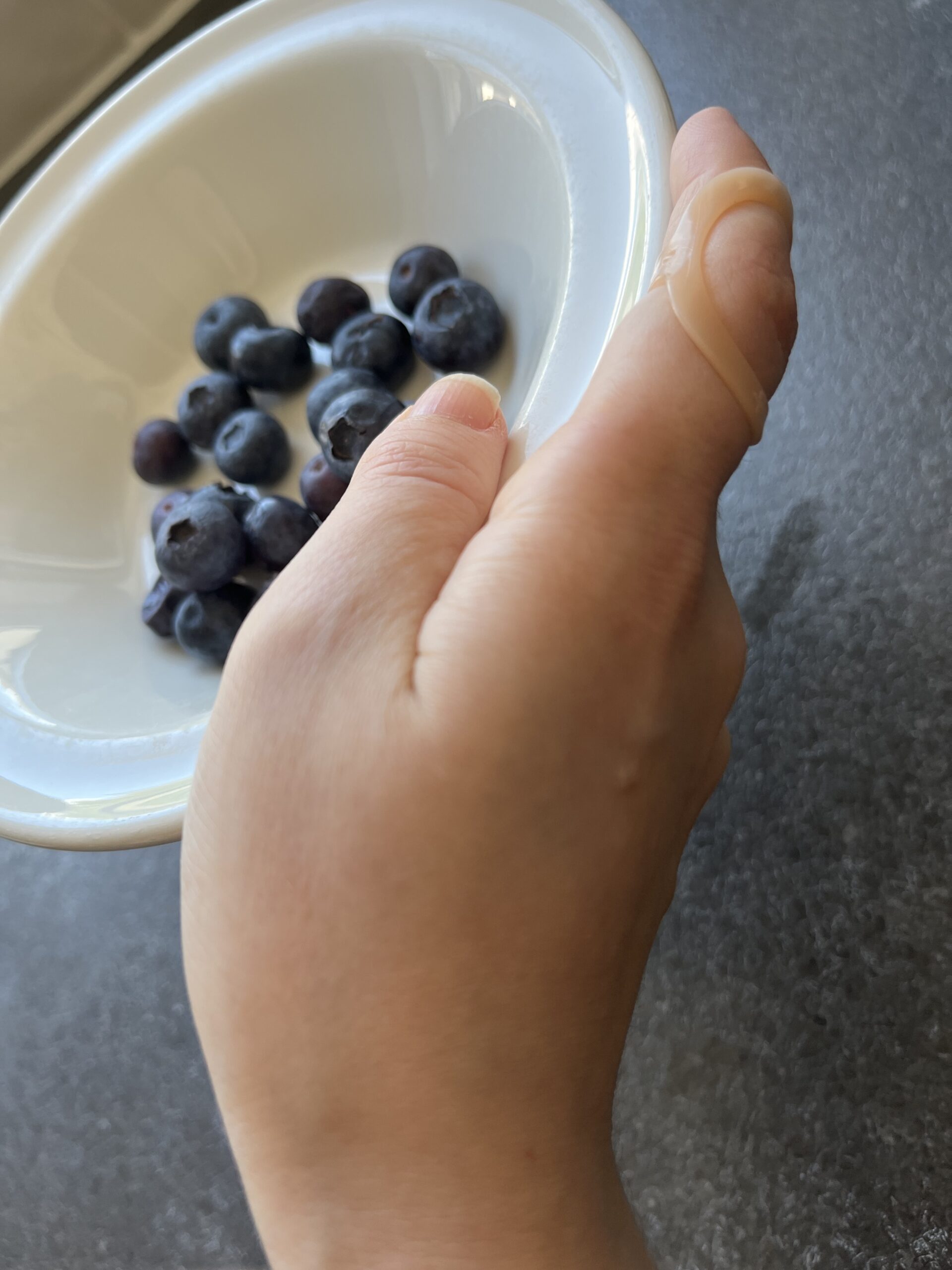
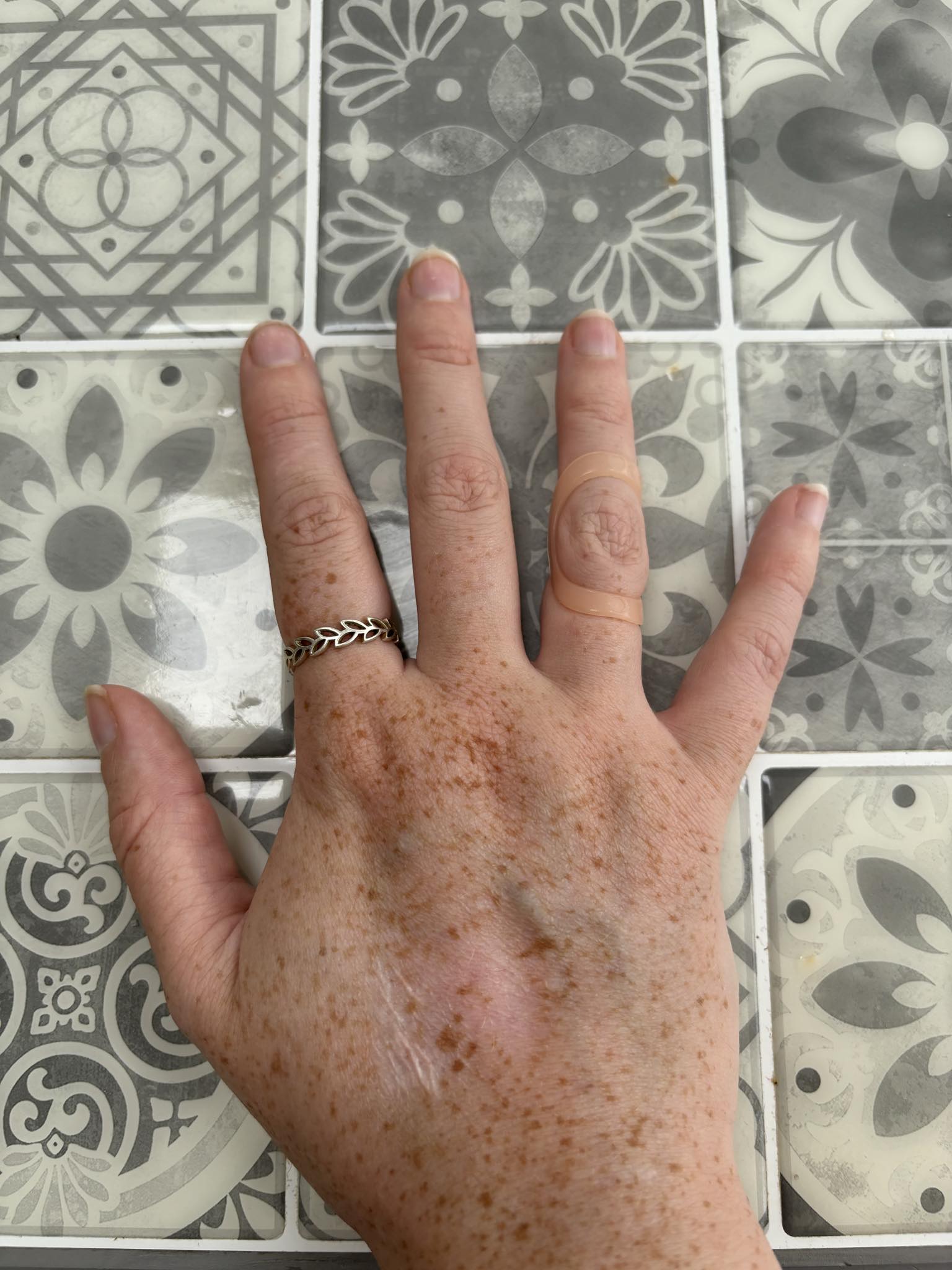
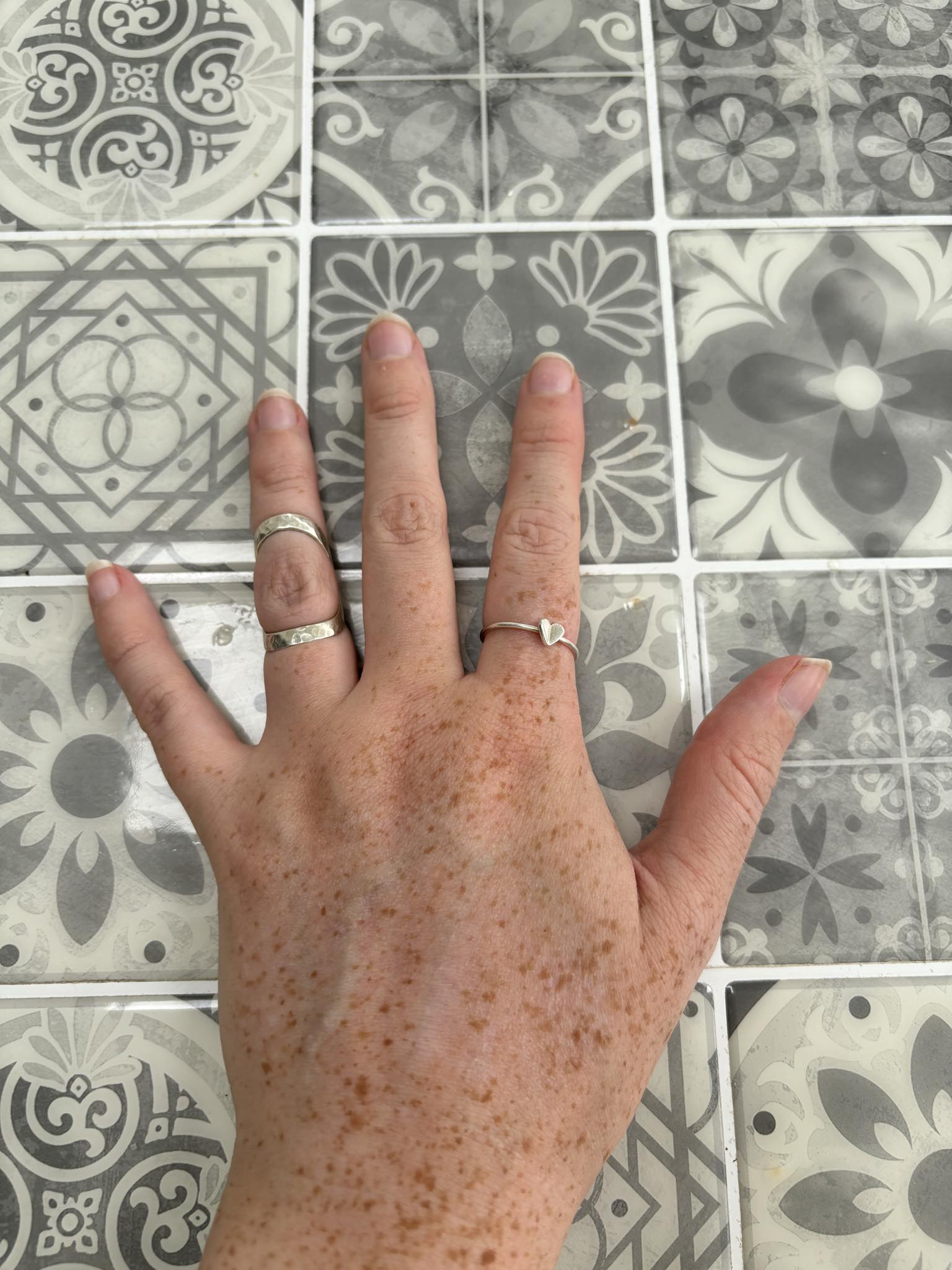
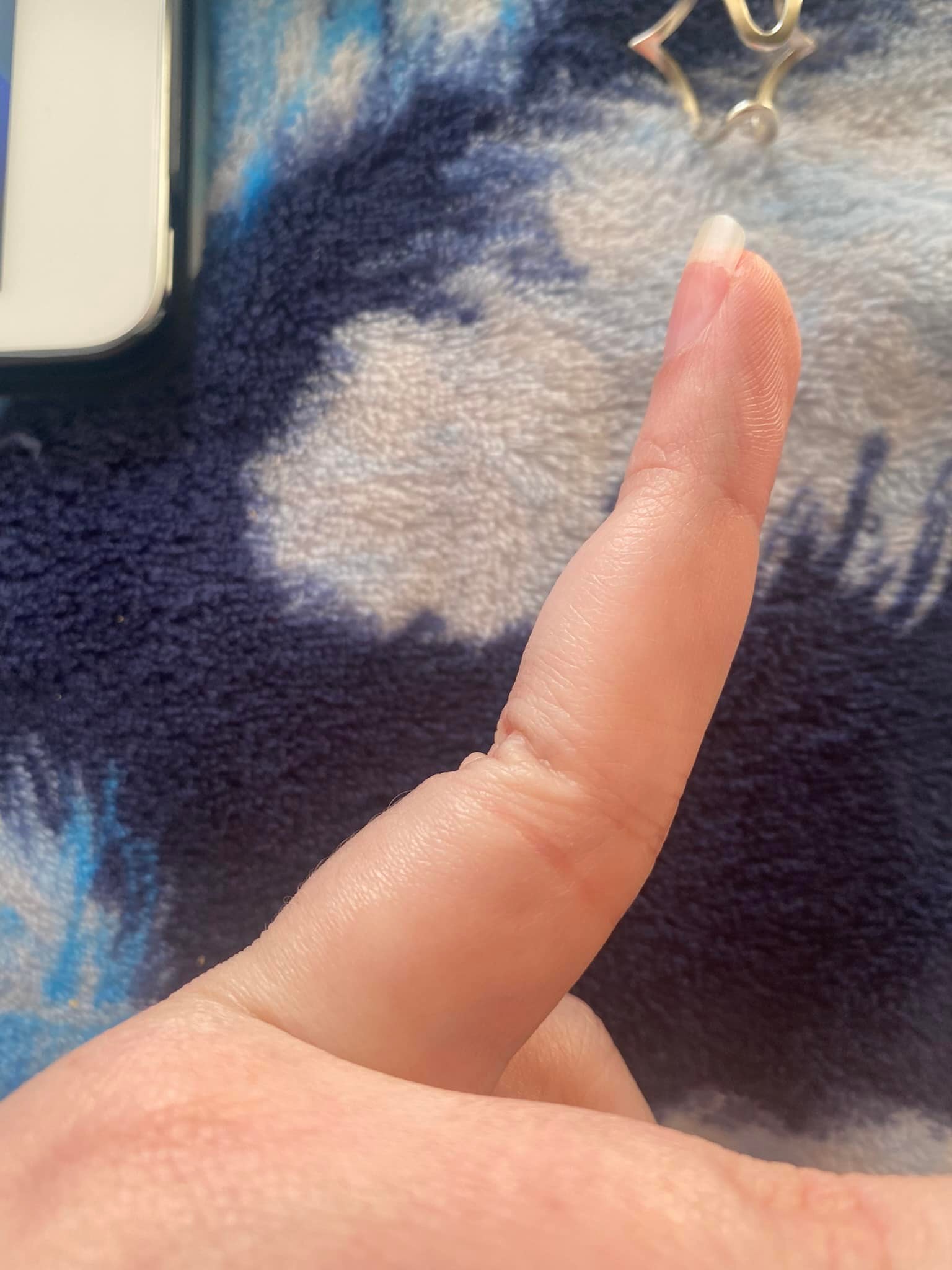
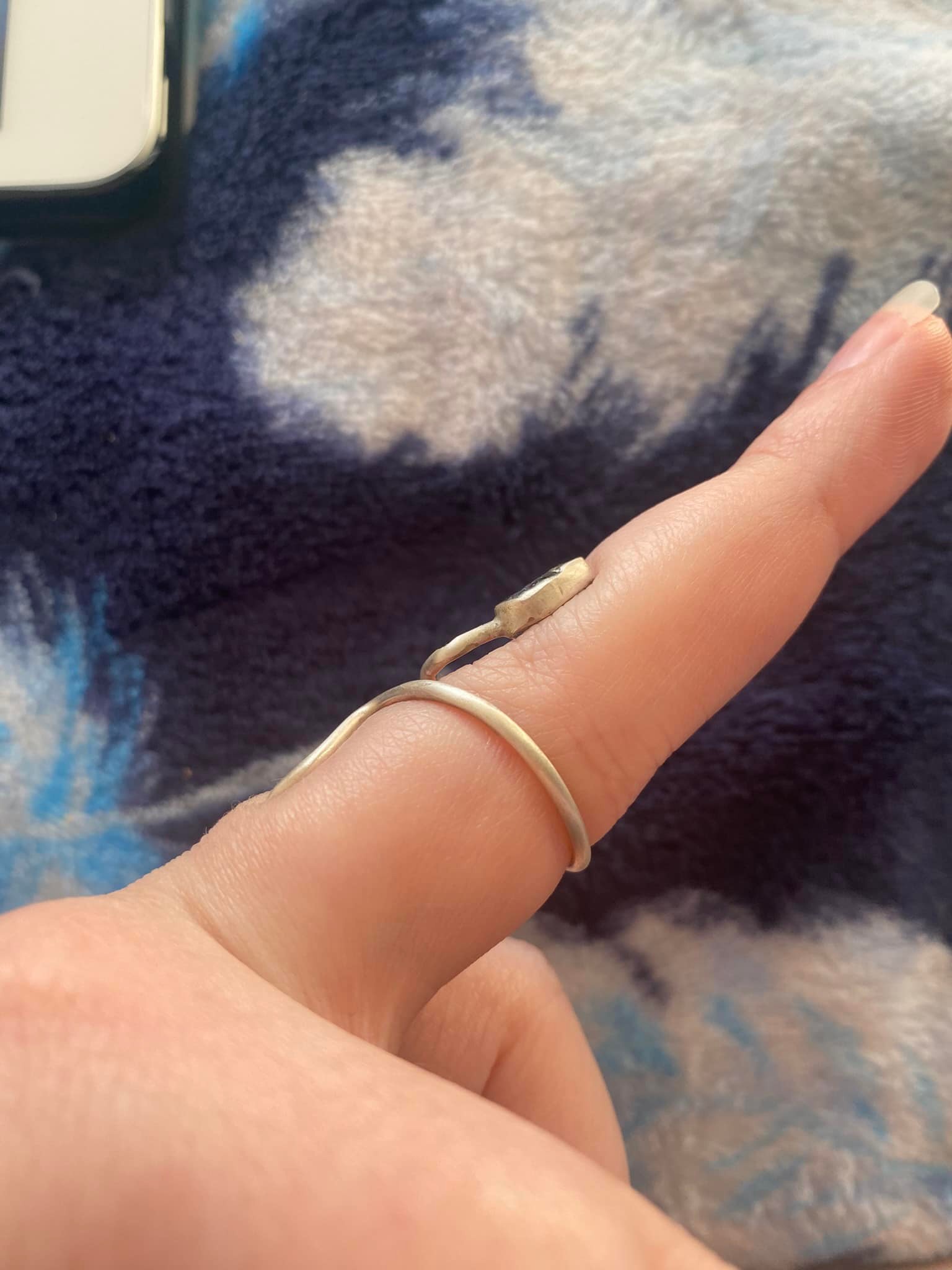
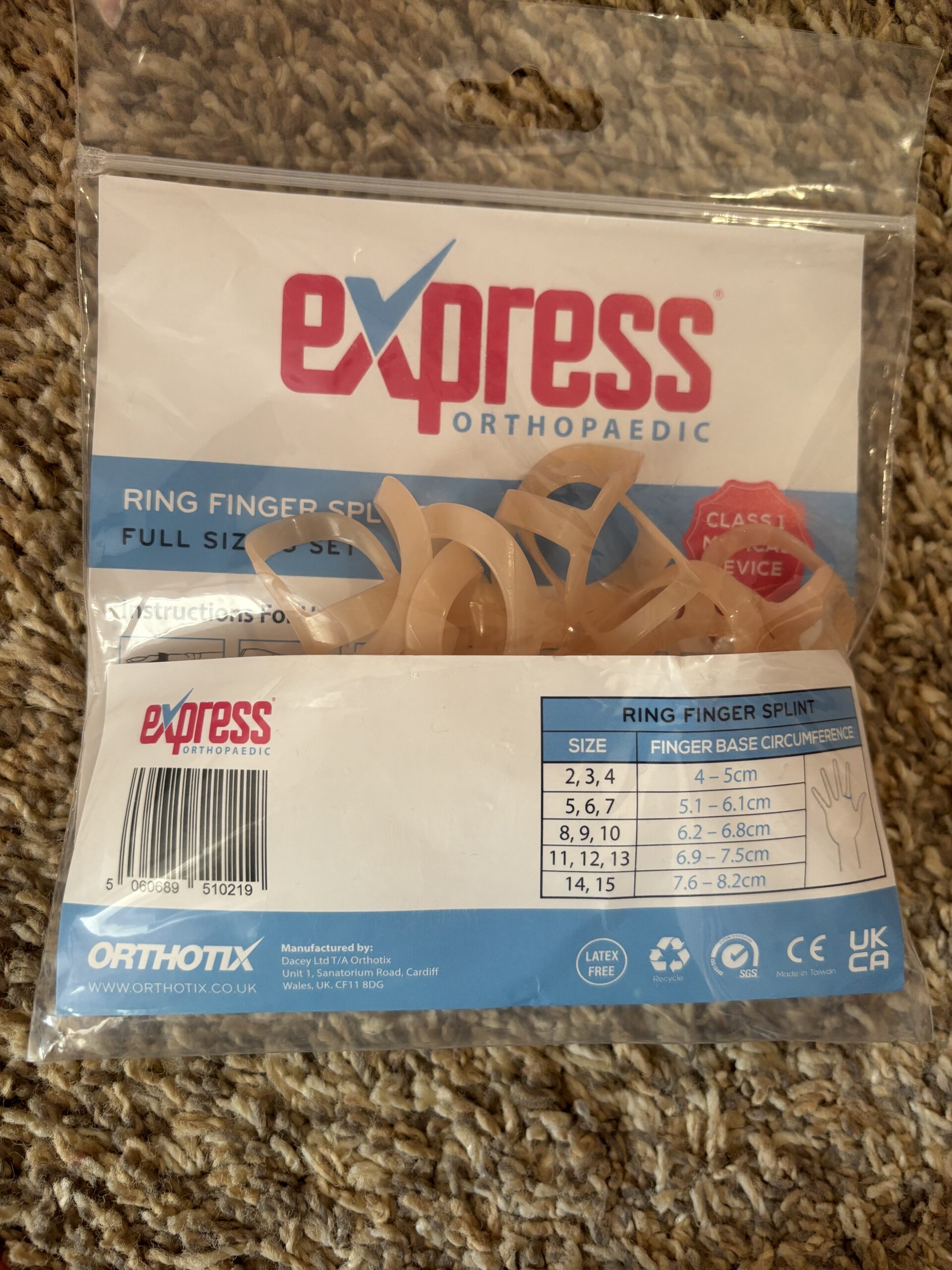
Many young people use ring splints to help keep their finger joints from over extending and causing pain in everyday life. In this section, several young people share why and how they use ring splints and the difference they make to them.
Laura explains what ring splints are.
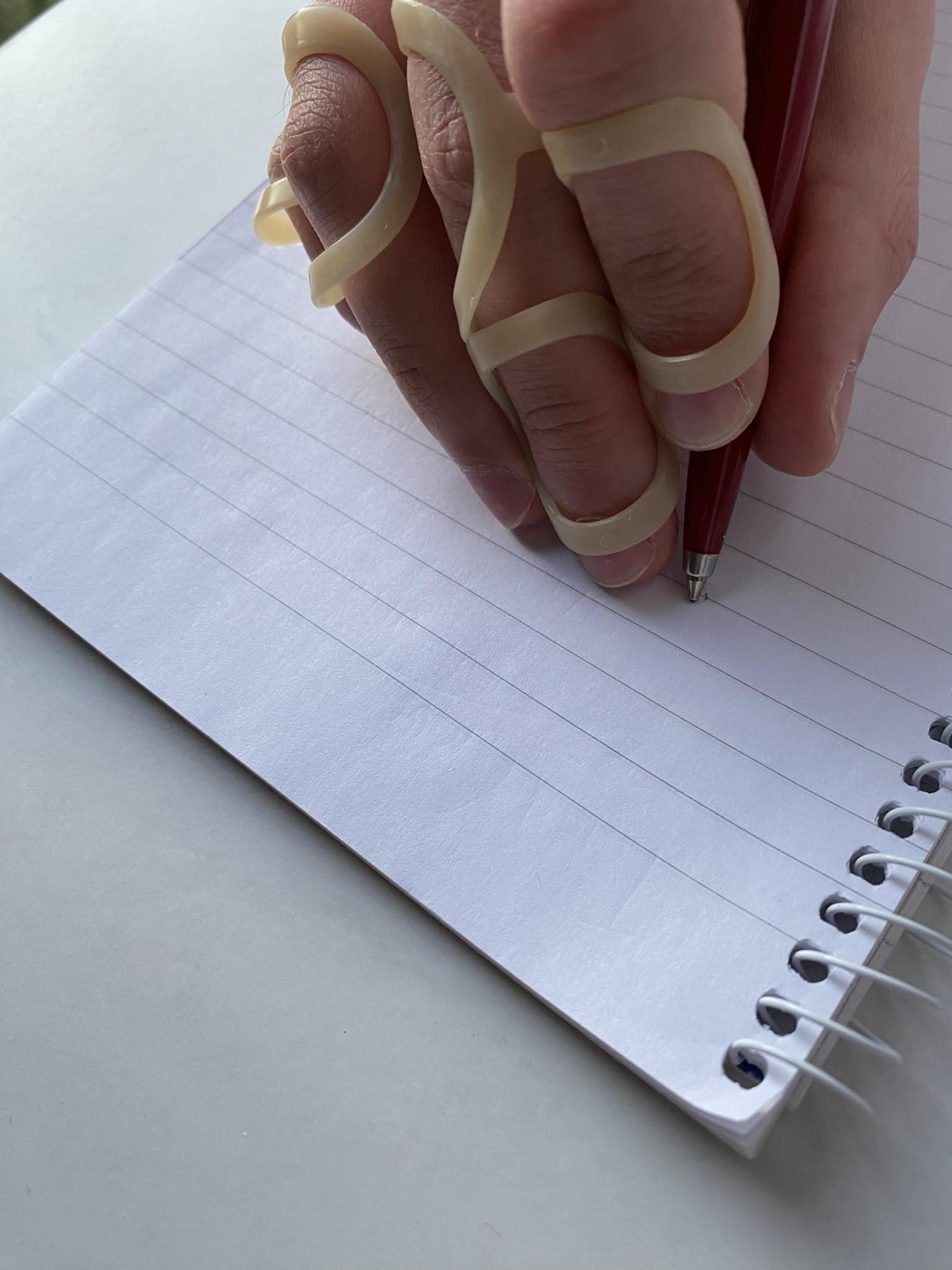
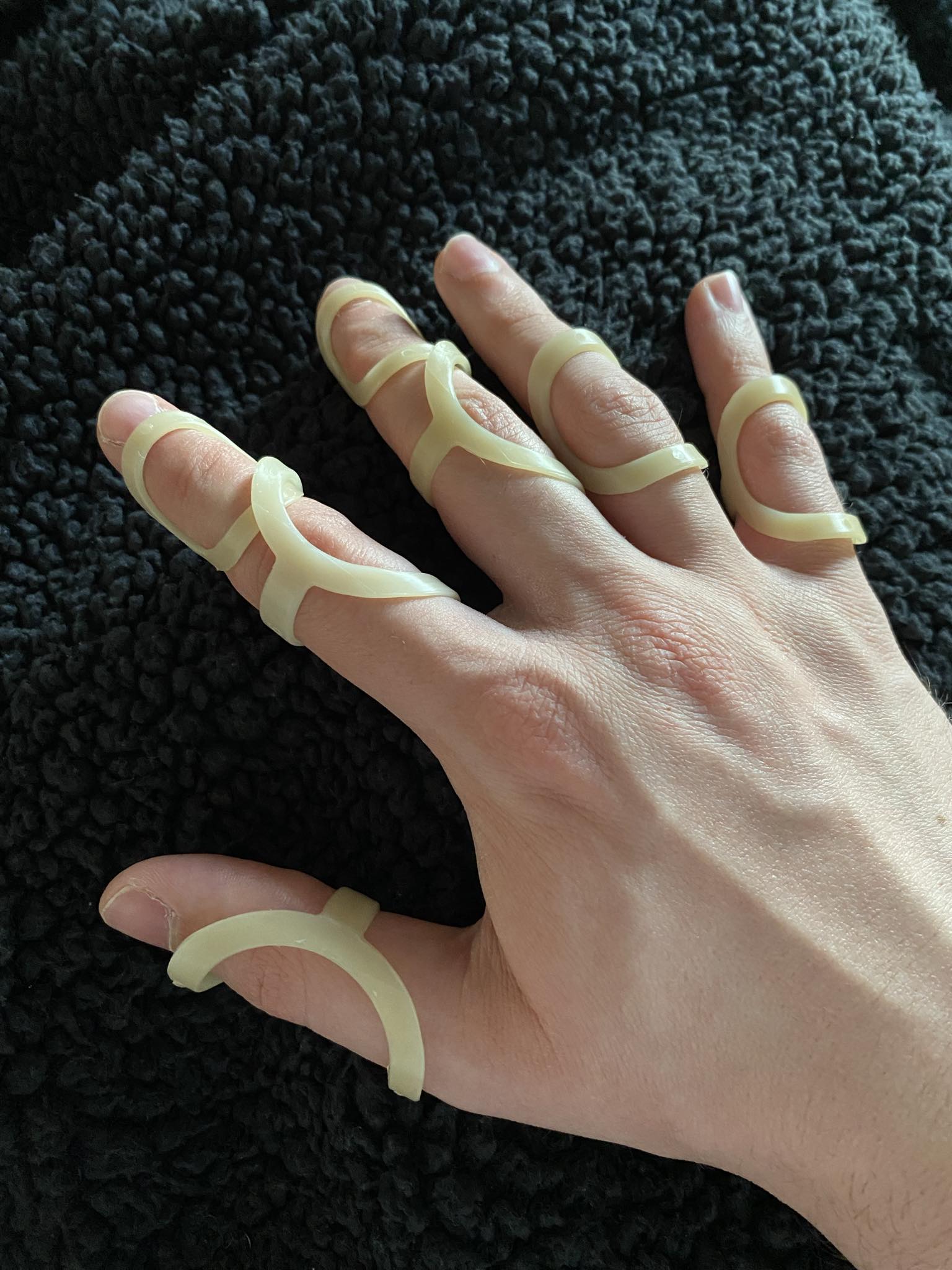
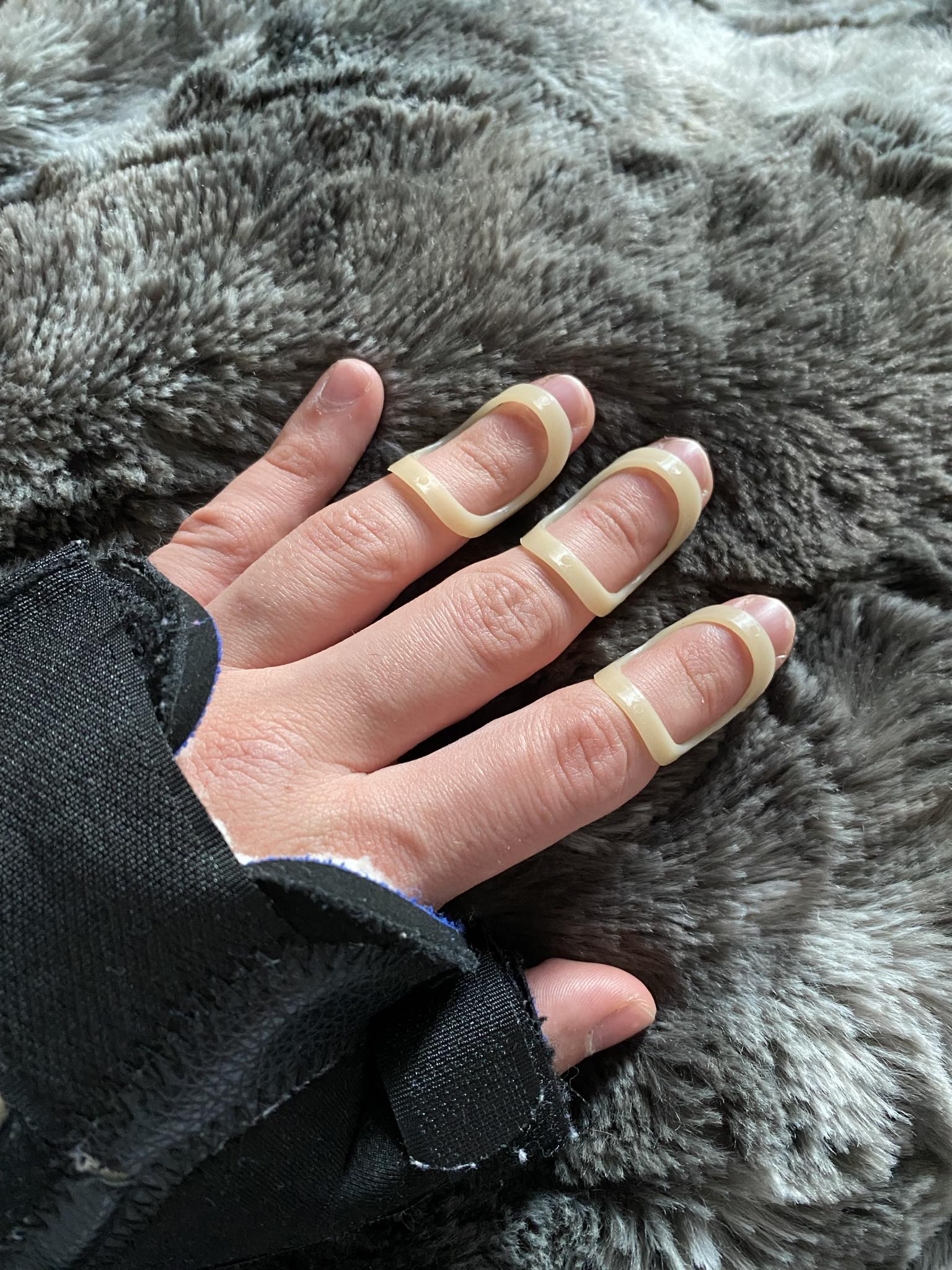
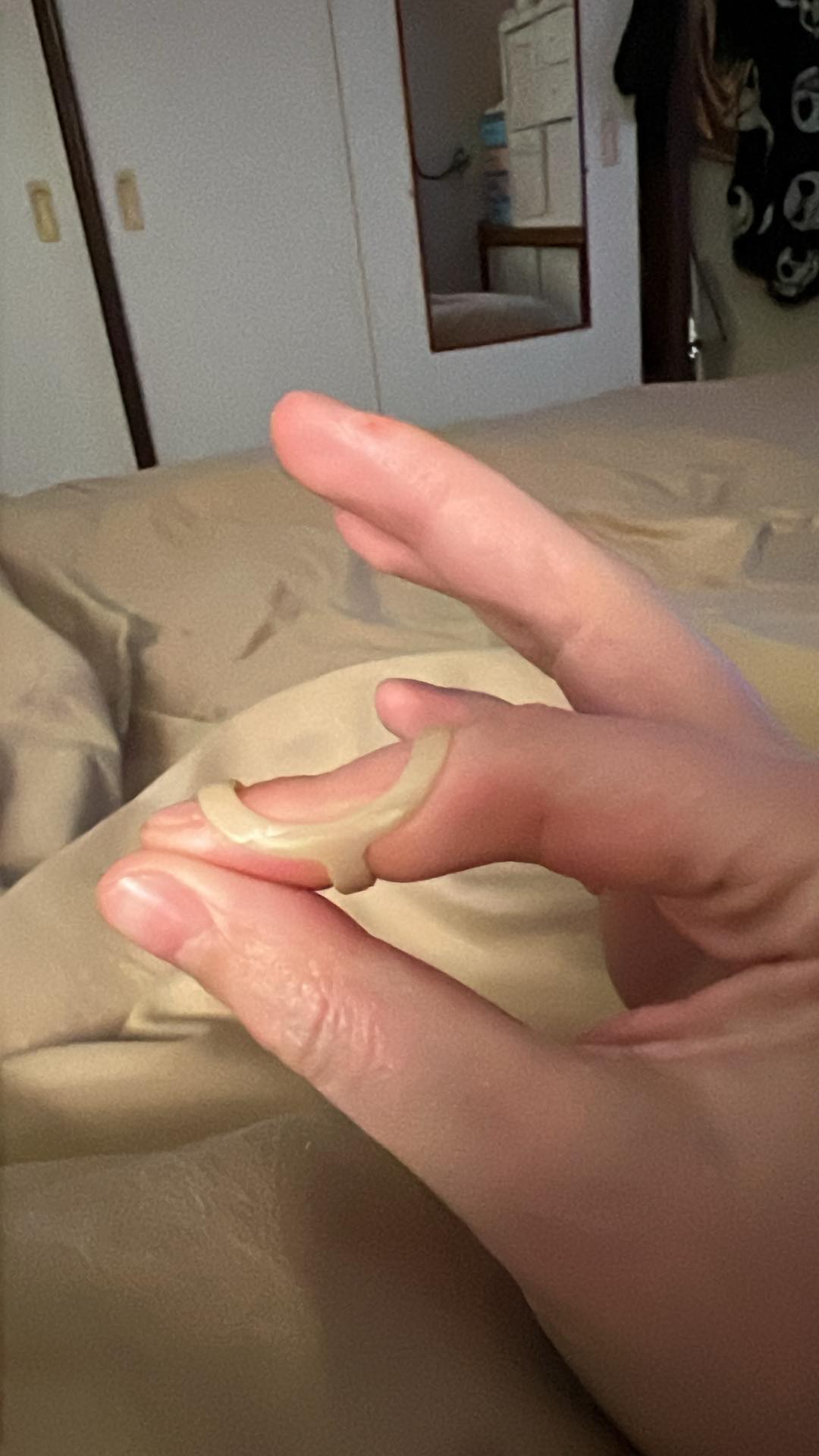
Ring splints can be used to help improve the stability, position and control the movement of the joints in the fingers and thumbs. The ring splints can reduce the range of movement of those joints, decreasing the chance of a subluxation or dislocation of the joints in the fingers and thumbs. Ehlers-danlos syndrome and hypermobility spectrum disorder can cause the fingers and thumbs to be extra bendy and move in directions that are not possible for other people so ring splints can be a good option to restrict these movements.
There are different types of ring splints that help support different joints in the fingers and thumbs. The type that is most appropriate will depend on which joints are flexible, painful and subluxed or dislocated. Ring splints are bought online or provided by orthotics / occupational therapy on the NHS. You can even make your own!
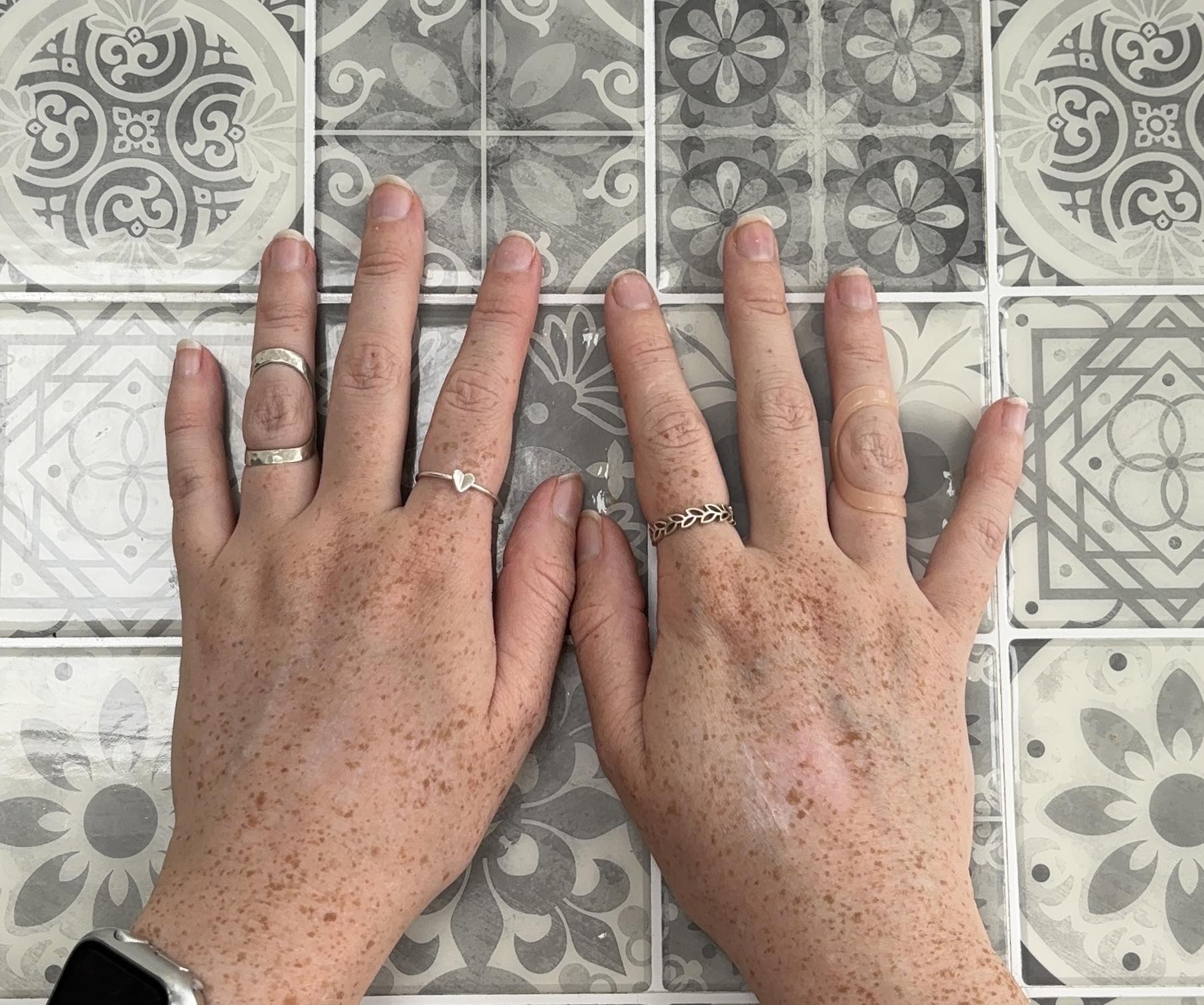
Rachael adds – It’s worth noting that both plastic and metallic ring splints can be worn in several different ways, to help and support a variety of different finger issues. Oval-8 rings tend to be fitted by a specialist on the NHS , this means that they are able to assess your hands and identify areas/joints that require the support. They are also able to try a variety of sizes on your hands to ensure they have the correct sizing for you, and they can use heat to help mould and shape the splint to you, essentially making a tailor made and completely custom Oval-8.
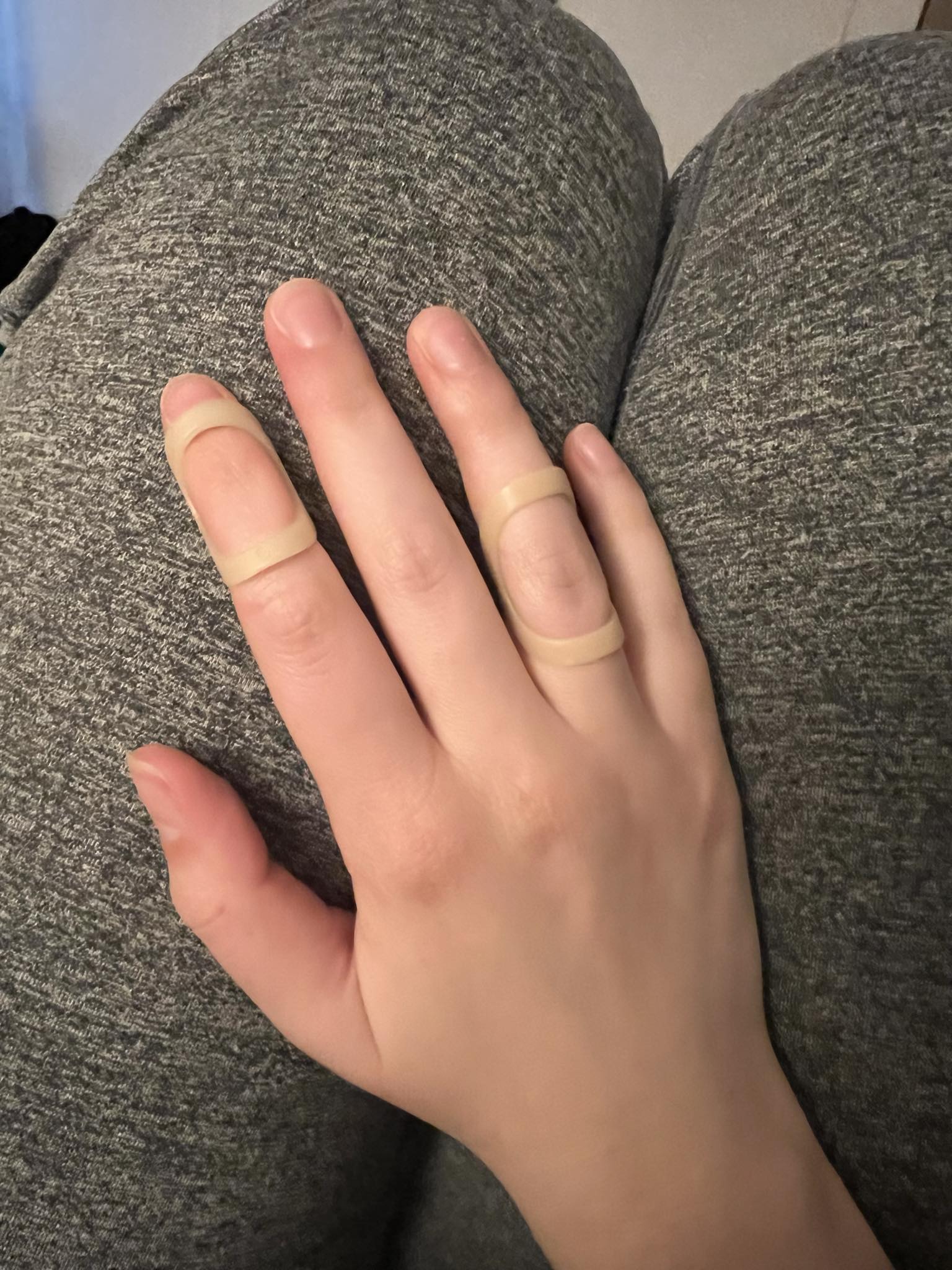
Lauras ring splints
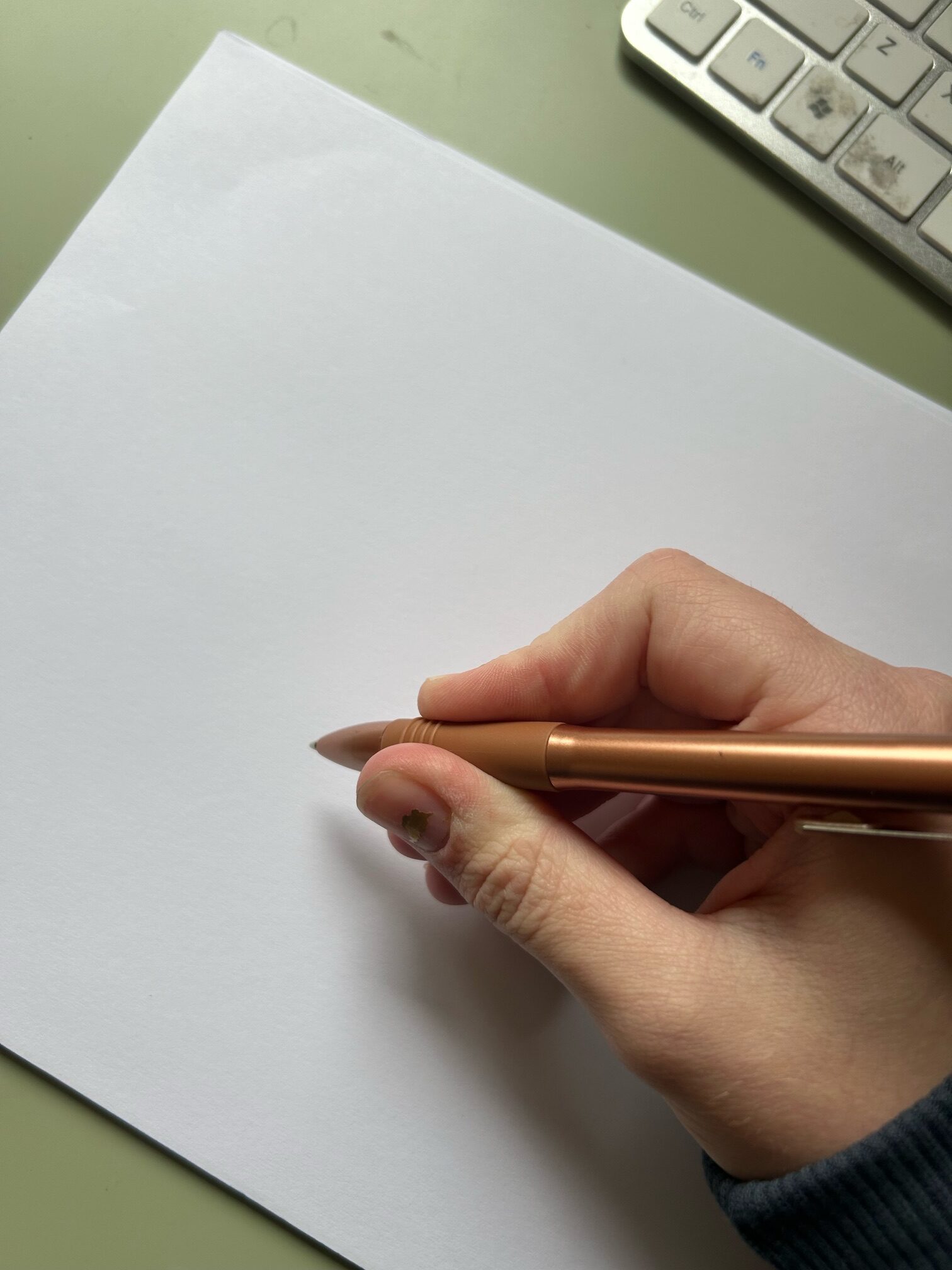
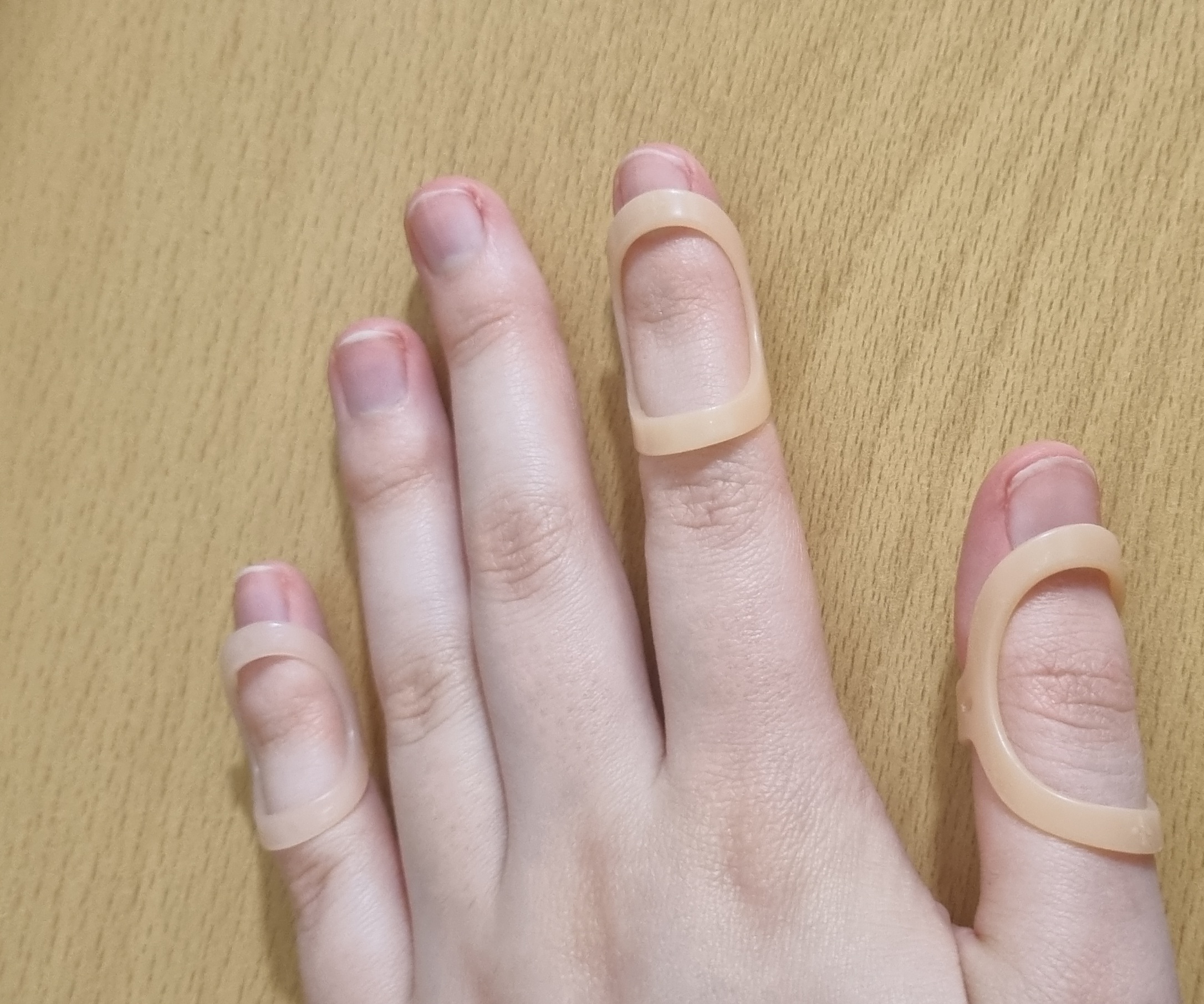
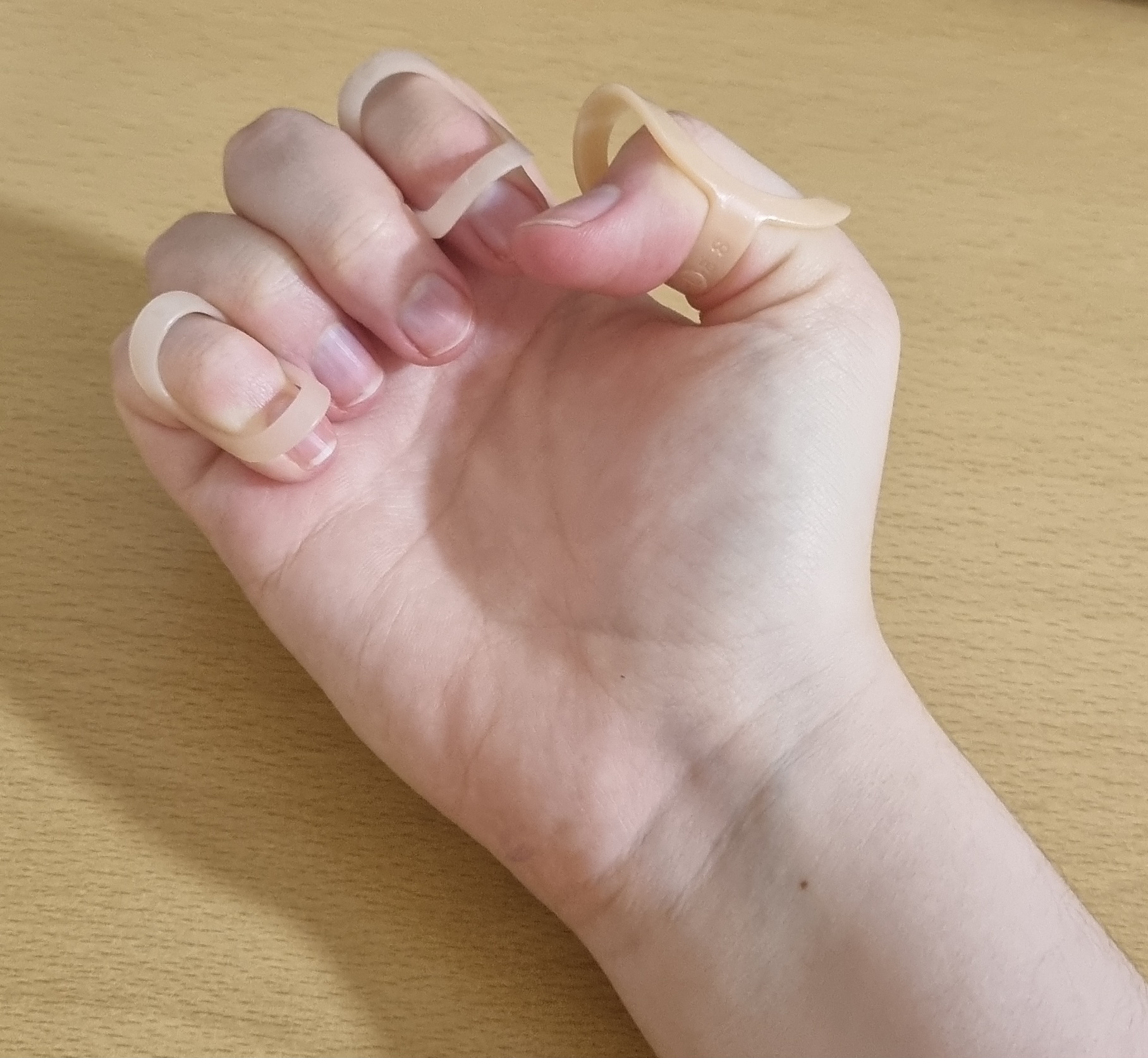
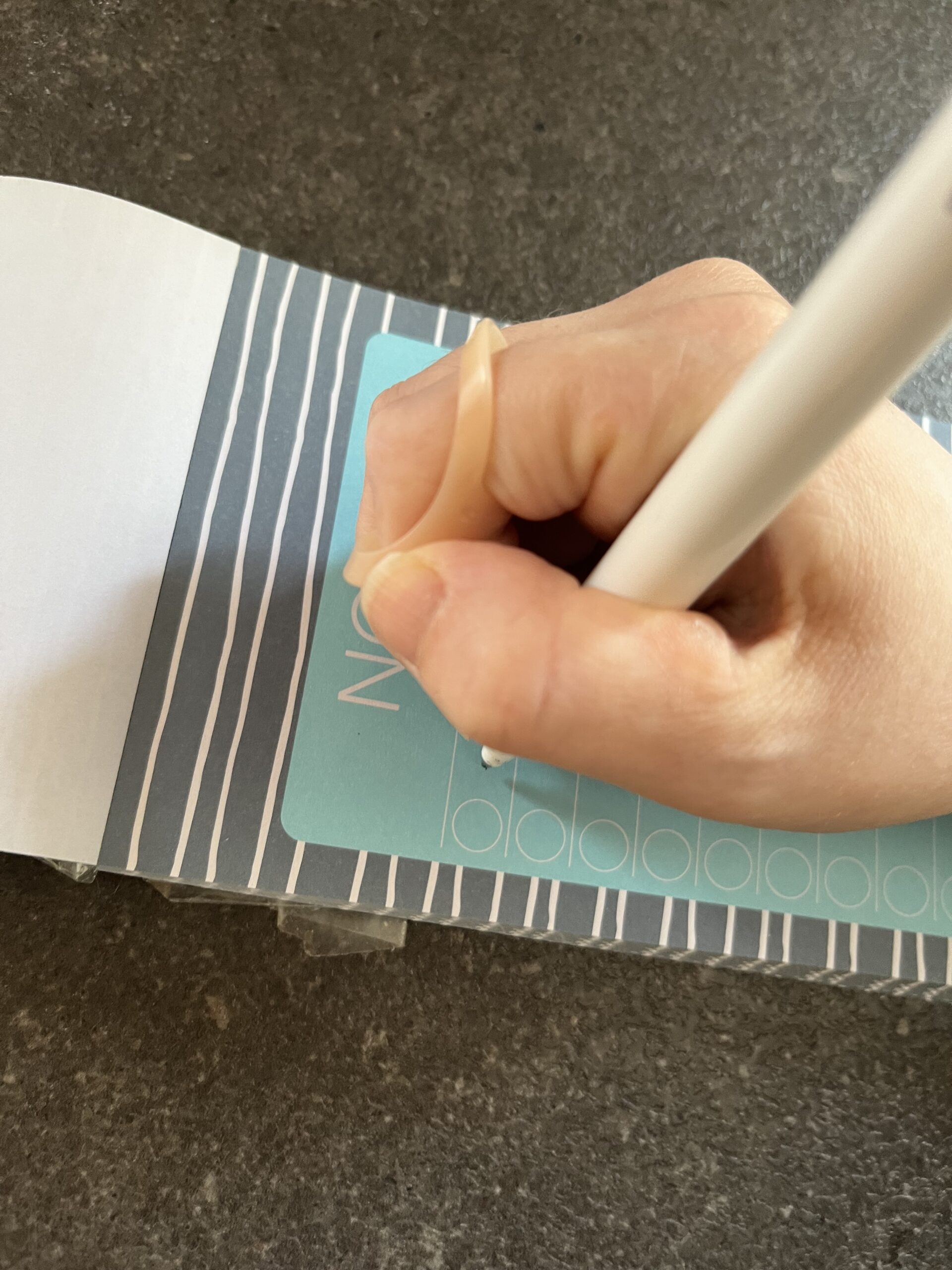
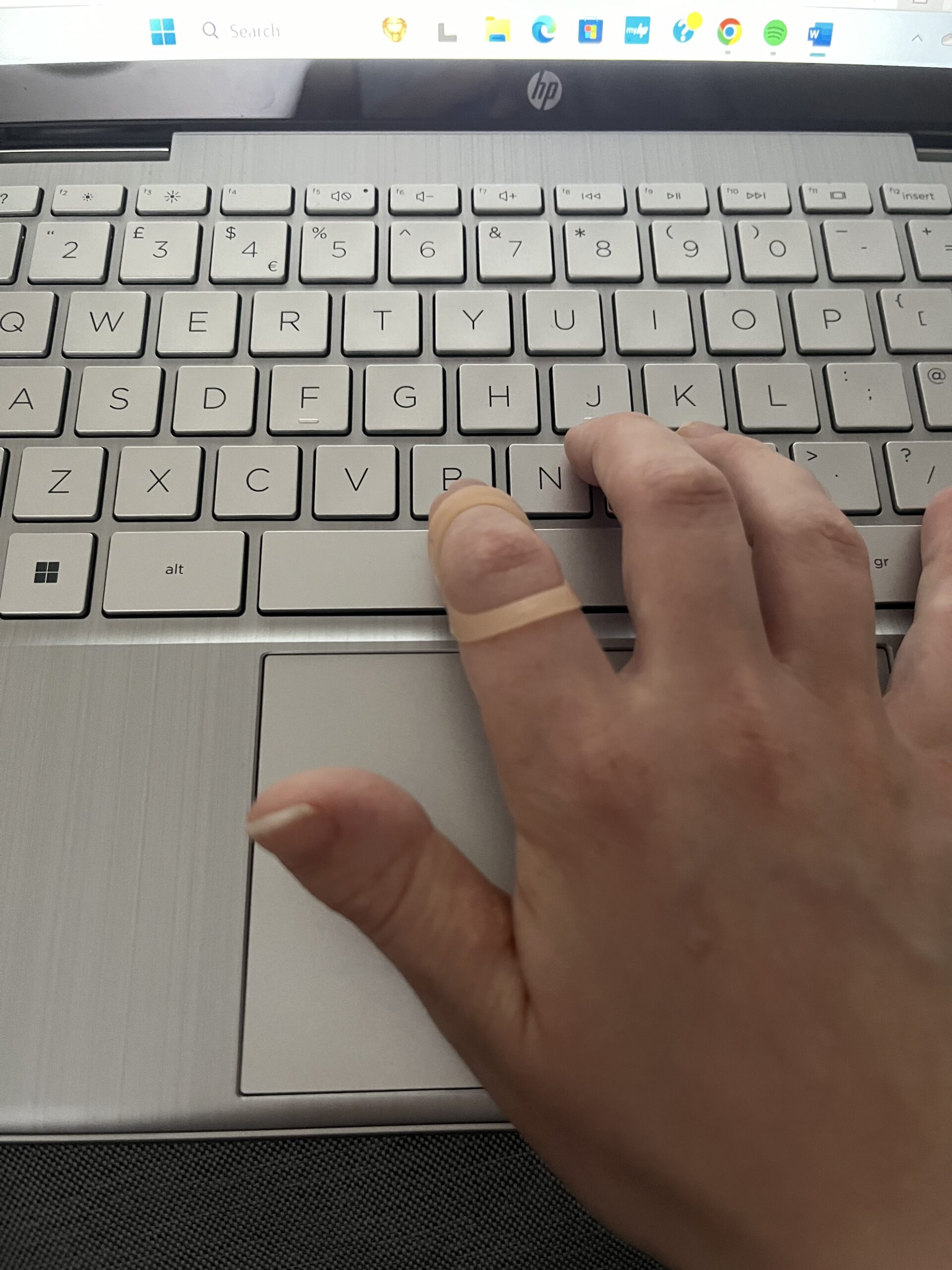
Personally, I wear plastic oval ring splints because my first and second fingers hyperextend (they bend backwards and look like a ‘w’) when I hold a pen and type on a computer. After a few minutes of typing or writing, I get pain in the joint at the top of my finger and the pain reduces how fast I can write. Using oval ring splints has helped stop my fingers being too bendy and they help keep my joints in a normal position so I don’t have as much pain in my fingers.
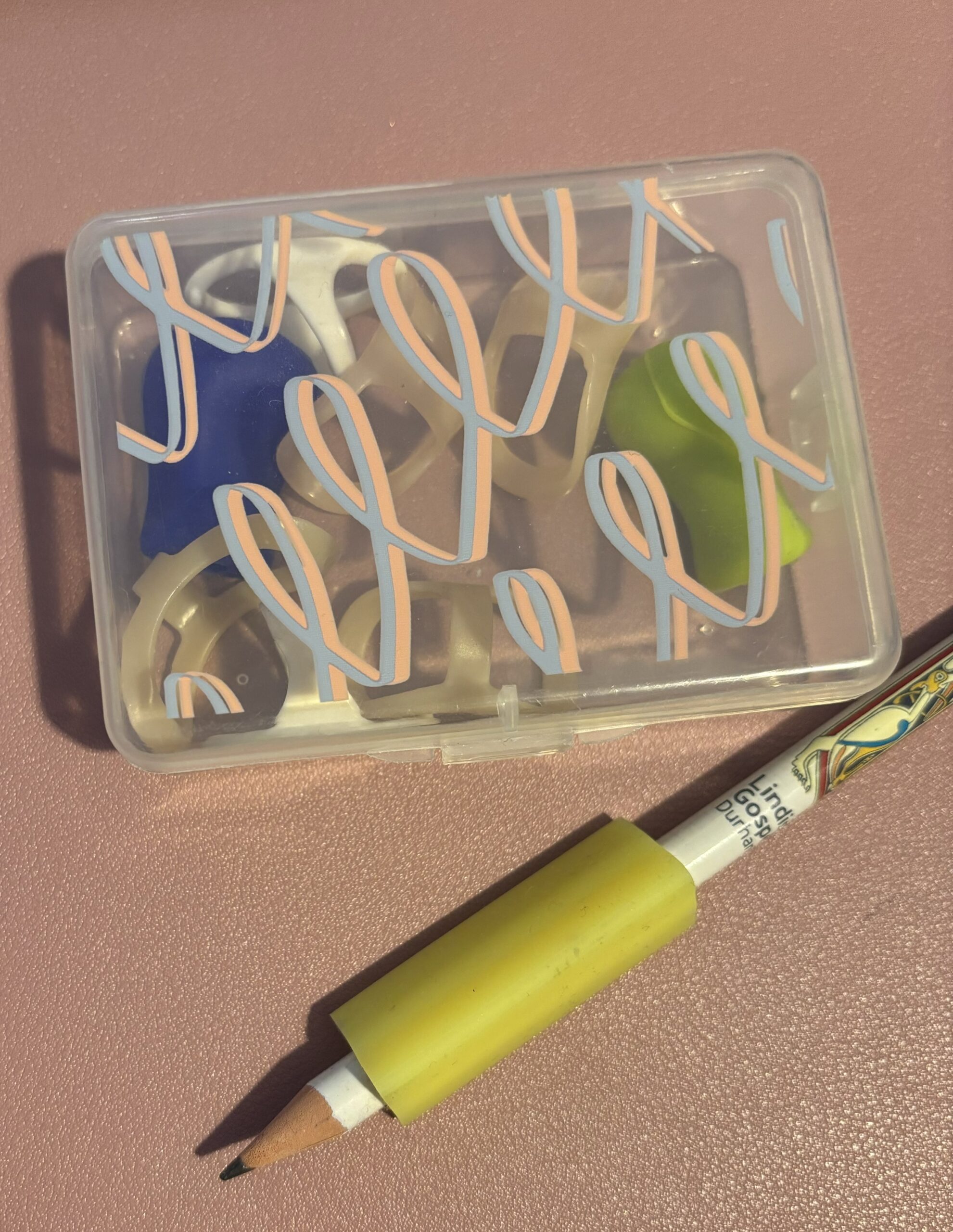
Also, I use silicone and triangular pen grips to help me hold a pen, as this reduces how much I have to grip the pen to write. I was recommended to buy plastic ring splints and pen grips online by my physiotherapist. I carry these around in a small plastic box so I can easily find them in my bag and use them when I am at university.
If you are buying them online, I would recommend buying a sizing set and then working out which sizes fit your fingers best. Also I find it helpful to carry two ring splints for each finger, as the size I need varies on whether my hands are hot or cold. If you find the ring splints uncomfortable and you need them for writing, another alternative is Finger Shark as they have a velcro strap that can be adjusted so they feel less restrictive than a rigid oval splint.
Emmas ring splints – I have only just started using finger splints in recent months, and what a difference they have made. At first, I was worried they would be uncomfortable but they are not. They do take a little time to get used to; maybe a few hours, but it is worth it. I wear one on my index finger on my dominant hand all the time, and on other fingers when I feel like I need extra support. It helps to limit hyper-extension and pain when writing and carrying out other tasks that require fine motor skills. I opted for plastic, as I find them comfortable and readily available. I also find them the most suitable for my needs. I like to have a range of sizes to have the most comfortable fit.
Alexs ring splints – I started wearing ring splints when I was 18 and struggling with my DIP joints, especially in my writing fingers. Writing and using cutlery was really painful and using ring splints has been really helpful in managing that pain while maintaining function. They’ve made typing and hand writing more comfortable while using a knife and fork is no longer a subluxation hazard. I’ve had oval-8 plastic splints as well as shiny silver ones. At the moment I’m preferring the oval-8 because they blend into my hands a bit more and there’s loads of sizes so if my fingers/hands are swelling I can easily change my ring splints over.
Lucys ring splints – I decided to start using ring splints as my finger joints were becoming unstable and I felt overwhelmed with physio exercises I was already doing. I have found the ring splints a simple and effective way to help bring stability to my fingers without requiring much effort from me.
I tend to use these when I am having to use my laptop for long periods of time or am doing a craft which is quite fiddley.
Sometimes, I need them to help me with tasks such as preparing food.
As time has gone on, I am able to notice the days when my fingers don’t feel as stable and I am now also able to notice when they feel stronger again to take them off.
Sometimes this is half an hour or a few hours later, the time will vary from person to person.
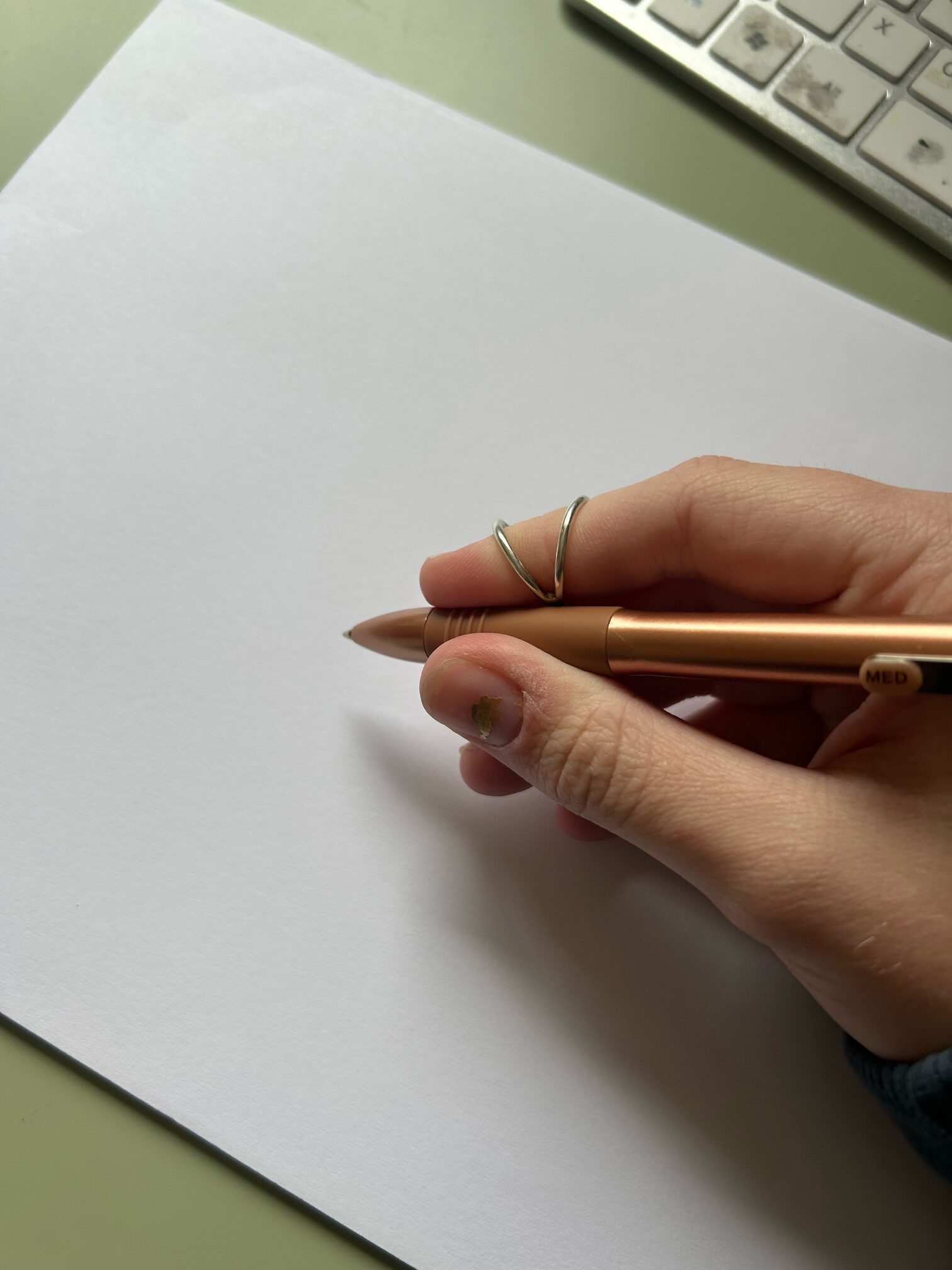
Emilys ring splints – I use a silver ring finger splint when writing as it helps prevent my finger overextending; therefore reducing pain and meaning I can write for longer.
Before using my splint, I would often struggle to write for extended periods, making lessons at school really difficult as I couldn’t keep up with the rest of my class. Now, I keep my splint in my pencil case so it’s there whenever I need it.
I got my splint from my physiotherapist.
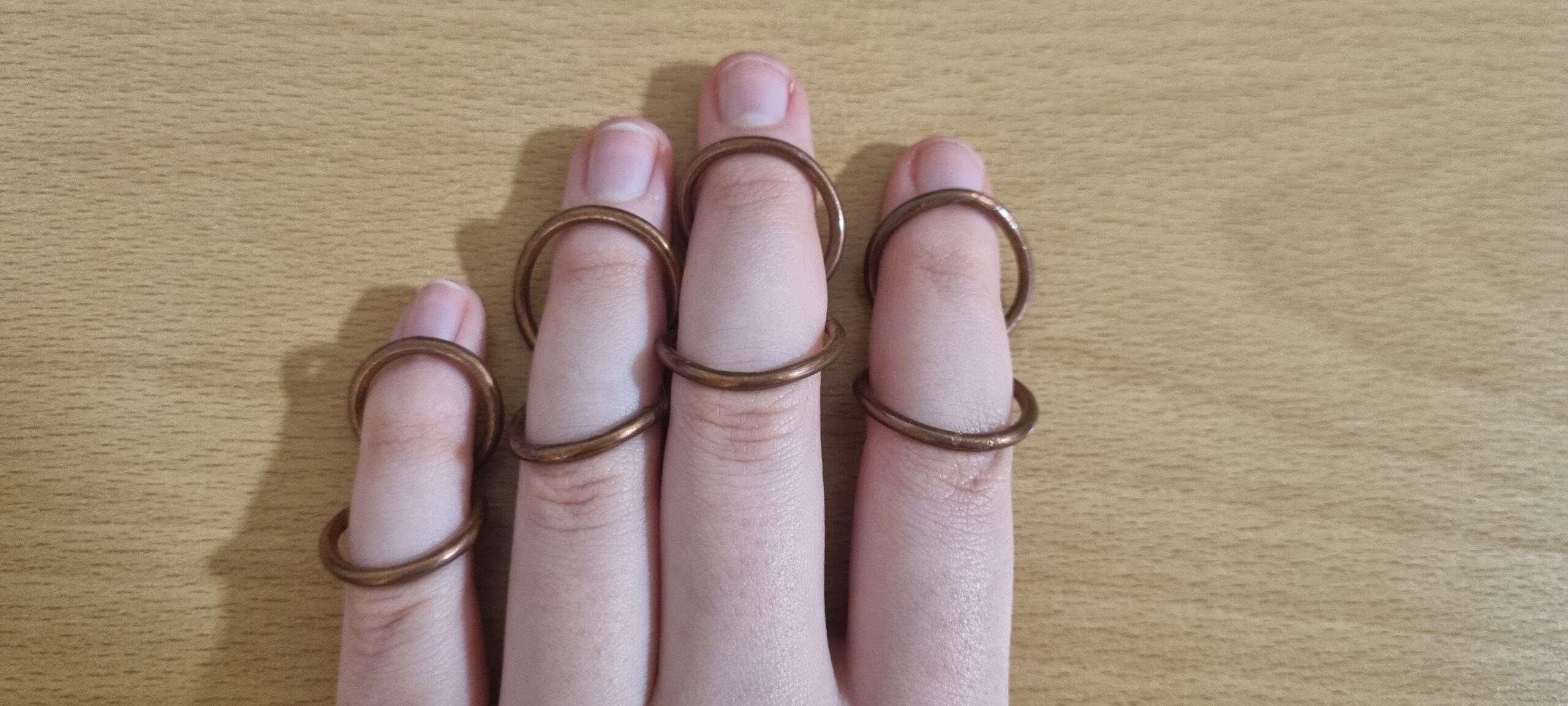
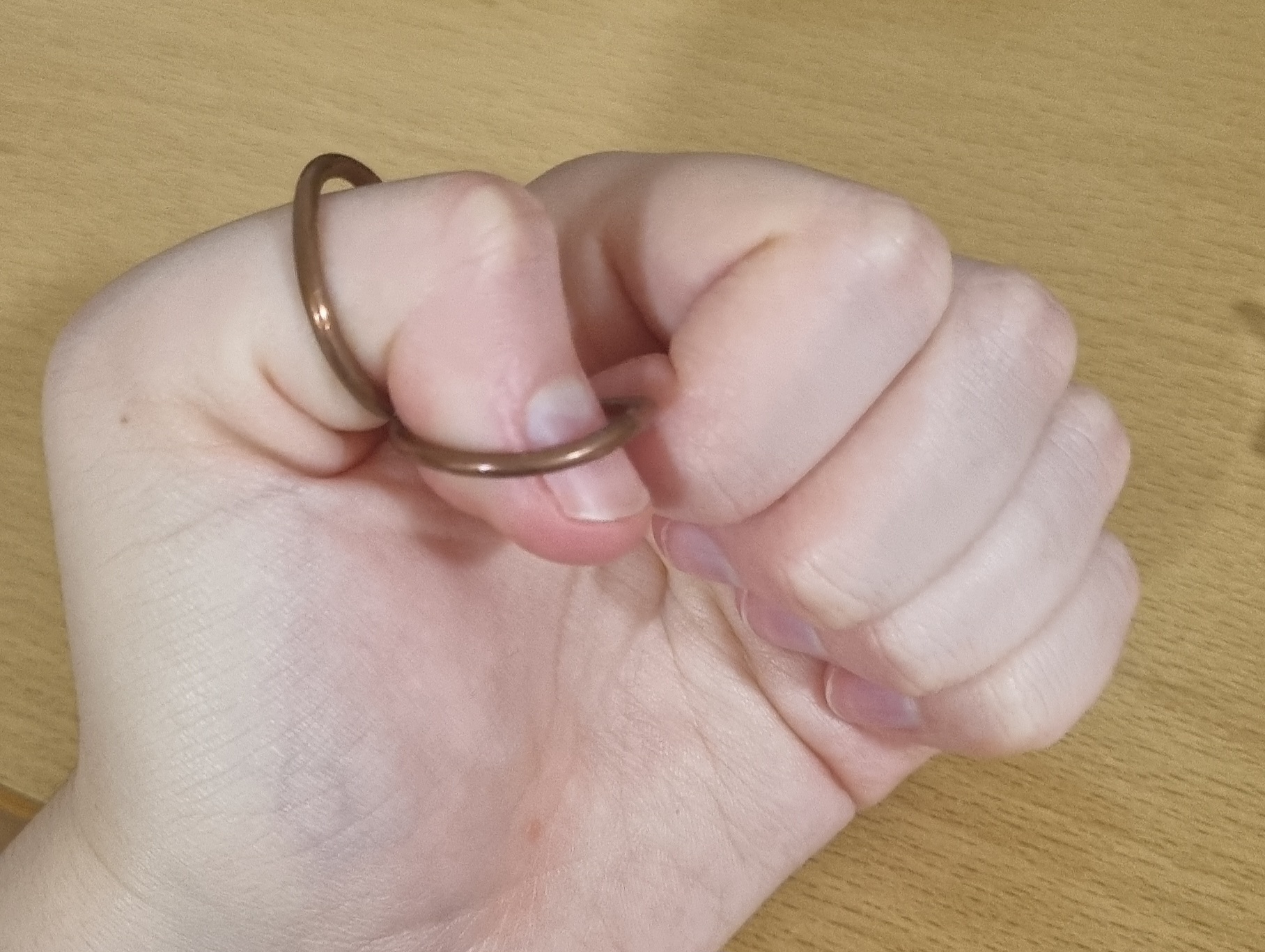
Hollie – I have both plastic and metal ring splints. In my first year of university, I had a project that involved using my computer mouse a lot and I was having issues pressing and holding this when my fingers just kept bending back. I spoke to my physio about this who was able to provide plastic ring splints in that appointment. They worked really well for stopping my fingers from bending the way they shouldn’t but the plastic cracked very easily and wasn’t the most comfortable. I’d noticed a friend at university using metal splints so I asked them where they had got them from and it turned out they’d made them themselves. They then made me a set. This involved taking measurements of my fingers, buying some cheap scrap metal, using pliers to bend them into the shape wanted and then using clear nail varnish to coat them to protect the metal. This meant that the whole thing cost just the price of the metal (which in this case was about £1) compared to other metal ring splints which can cost £100s. Metal splints can often look nicer and be more durable than plastic ones. Self-made metal ones can be a bit rougher than professional ones but they are a good way to save money and, in my experience, are still a significant upgrade from plastic splints. If you’re currently waiting to be able to access splints, a good tip I was given for things like pressing buttons and using blu-tac is to bend a finger and use your knuckle instead of your finger tip.
Rachaels ring splints
Plastic Ring splint brand: Oval-8 Silver ring splint brand: Ring Splints by Zomile It’s worth noting that both plastic and metallic ring splints can be worn in several different ways, to help and support a variety of different finger issues. Oval-8 rings tend to be fitted by a specialist on the NHS , this means that they are able to assess your hands and identify areas/joints that require the support. They are also able to try a variety of sizes on your hands to ensure they have the correct sizing for you, and they can use heat to help mould and shape the splint to you, essentially making a tailor made and completely custom Oval-8. From my experience I’ve always had a follow up, when being fitted for Oval-8 splints, this is so that they can ensure the splints are comfortable and supportive and adjustments can be made if required. Silver ring splints tend to be ordered over the internet, either through direct websites or via platforms such as Etsy. The issue with this, is that you need precise measurements in order for the size of the splints to be correct. Measuring at home can be very fiddly and a little bit tricky, but in my experience with Zomile – I have found her to be very helpful and willing to answer any questions I may have. Some people prefer metallic based oval-8’s due to their looks (which are often customisable as you can choose the colour and finish of the metal as well as choosing to add texture or jewels on the splint), and I frequently get compliments on my silver splint. In my experience I’ve also found silver splints to be less bulky as the metal is thinner than the plastic. I would recommend anyone who’s interested in trying splints to try and Oval-8 first, as they are available on the NHS, just to get used to seeing how they feel on your hands and to identify wether they are beneficial to you. It’s also worth noting that hands change shape with weight fluctuations, so if you do suffer from issues that could cause weight gain or loss, it may be beneficial to have Oval-8’s until your weight is stable, otherwise buying new splints every few months can become expensive. It’s also worth noting that there are a variety of makers and sellers of the Ring Splints, and they can vary in price. I have chosen Zomile, as she was highly recommended to me from members of the EDS UK and Wales group. I have purchased from elsewhere, however I found the quality of the metal was poorer and caused discolouration to my fingers, and the splint itself ended up bending and being unusable. A few differences I have noticed between plastic and metallic splints: – Zomile’s Silver Ring Splints are slightly less bulky in comparison to the plastic Oval-8’s. – Oval-8’s can wear down slightly especially if you wear them 24/7 as I do, however they are replaced on the NHS (although my current Oval-8’s have lasted 2 years and still have plenty of life left in them) – Oval-s to blend into skin and provide a subtle and discrete look, whereas Zomile’s splints stand out more and can appear to be jewellery. – The Oval-8’s are able to be adjusted and resized to you in-person – Oval-8’s are fitted in person whereas you need to send your measurements online for silver ring splints – Oval-8’s are fitted free of charge on the NHS whereas Silver Ring Splints are self-funded Similarities I have noticed between plastic and metallic splints: – Both are extremely comfortable for prolonged wearing but only if fitted and sized correctly – Both are easy to keep clean – Both age well, and are functional for long periods of time – Both can be utilised in serval different ways to provide support for multiple different issues with the fingers/hand. – both are made from high quality materials
Some may need no/minimal adaptations and aids. Some may need a couple. Some may need lots from one category and none from any others. Some may need something or lots from them all.
We all experience pain differently and we are all affected differently and we all require different support and tools to help us through. Your severity of struggle isn’t defined by aids or adaptations, it is defined by you and your day to day experiences. Everybody has a space within the EDS/HSD community, and everybody is valid. Do what you feel is right for you and your body.
- Aids in/around the house/flat
- Kitchen aids
- Laptops
- Writing equipment
- Home adaptations
Aids in and around the house/flat some may find the following useful to help manage their pain (there may be other things you find helpful that aren’t on this list)
- Shower stool
- Kitchen stool
- Long handled brush for showering/cleaning yourself
- Bathing cushion
Kitchen aids some may find the following useful to help manage their pain (there may be other things you find helpful that aren’t on this list)
- Lightweight plates, bowls, dishes etc.
- Vegetable Chopper
- Non slip jar opener
- Stand alone automatic whisk/mixer eg. A kenwood KMix, there are other brands/cheaper makes available.
- Self-pouring kettle.
- Trying all the different types of hand cheese graters to see if there is one which your body likes or you can try an electric/rechargeable cheese grater.
- Electric tin opener
Adaptations to and aids for laptops some may find the following useful to help manage their pain (there may be other things you find helpful that aren’t on this list)
- Comfort mouse and mouse mat
- Softwares to help with using the computer
Aids to help with writing with pens/pencils some may find the following useful to help manage their pain (there may be other things you find helpful that aren’t on this list) [5]
- Experimenting if writing with pen or pencil makes a difference
- Using triangular pencils may be helpful to some
- Using different types of pen grips
See more regarding this on the school toolkit, under the ‘reading, writing and exams section’
https://theschooltoolkit.org/reasonable-adjustments/
Some people may require home adaptions. These can be things such as handrails on the stairs all the way to having work done on the home.
Adaptations to the school day and exercise sessions may also be helpful for some. Find more information about this on the ‘education’ section of this website and on this page you will find information on exercise and some top tips for education.

Ring splints