The Ehlers-Danlos syndromes (EDS) GP Toolkit

The Ehlers-Danlos syndromes (EDS) are heritable connective tissue disorders affecting the quality of collagen in every part of the body1. They were once considered to be very rare and only seen by rheumatologists. There are 13 types of Ehlers-Danlos syndrome, most of which are indeed rare2. However, the hypermobile type of EDS (and associated hypermobility spectrum disorder) is thought to be common and this toolkit will focus primarily on this type, although many of the clinical signs and symptoms discussed can also appear across the other EDS types. The old diagnosis of Joint Hypermobility syndrome (JHS) is now considered part of the spectrum of Hypermobile EDS3.

Hypermobile EDS is now understood as a multi-system disorder which can have a marked impact on health and which may help us to explain apparently mysterious multiple symptoms4,5.

This toolkit sets out the latest thinking in EDS, including the new approaches to diagnosis and treatment set out by the International Consortium on the Ehlers-Danlos syndromes in 20176, as they relate to primary care.

The Ehlers-Danlos syndromes received a major overhaul in 20176 and this is what we now know:

  • EDS are heritable connective tissue disorders affecting the quality of collagen in every part of the body1.
  • There are now 13 recognised subtypes of EDS, 12 of which are genuinely rare and have the aberrant gene identified2. Information on the national diagnostic services in London and Sheffield can be found on this link.
  • Hypermobile EDS (hEDS) and hypermobility spectrum disorder (HSD) is by far the most common type; these conditions are part of a spectrum and the distinction is hoped to be useful for research, but is otherwise academic4,7,8,54.
  • hEDS/HSD is a multi-system disorder which can have a marked impact on health and which may help us to explain apparently mysterious multiple symptoms1.
  • Don’t let the changing terminology confuse you. 3.4% of the population have generalised joint hypermobility and chronic widespread pain (a proxy for the now obsolete diagnosis of joint hypermobility syndrome (JHS).
  • Patients who in the past received a diagnosis of JHS (or Benign JHS), EDS-Hypermobility Type or EDS Type III would now be categorised as having hEDS or HSD 3,9. New diagnostic criteria for hEDS (PDF).
  • “If you can’t connect the issues, think connective tissues”10, Non-specific and medically unexplained symptoms are usually real and should not be dismissed1112. It can be easy to make a big difference to the quality of life of some of your most complex patients with a few simple and inexpensive measures, but the journey starts with recognition.
  • The median time from symptom onset to seeking a GP opinion is 2 years and the median time to diagnosis 10 years13. If we make an early diagnosis and manage the conditions appropriately, there may be potential to reduce long term disability which can occur from EDS1,14,15.
  • Enquire about family members; these are hereditary disorders of connective tissue so positive family histories are common2,16. Although no gene has yet been identified, hEDS is primarily of autosomal dominant inheritance16.
  • Children can present with symptoms of hEDS/HSD, including abdominal symptoms17,18,19,20,21,22,23,24,25 or growing pains26. They may also present with neurodevelopmental disorders such as hyperactivity27, inattention27, dyspraxia28, autistic spectrum disorder29,30,31, sleep32,33,34,,35, and food issues36,37,38,39,40,41,42,43, emotional problems, hypersensitivity and anxiety44,45.
  • A low Beighton score does not exclude hEDS/HSD3,46,. Patients stiffen with age so their Beighton score may decrease, although pain may worsen47. The extent of multi-system symptoms is not related to the Beighton score.
  • Consider co-existing conditions; In recent years, we have begun to understand more about associated or co-morbid conditions which are frequently found in people with hEDS, including autonomic dysfunction3,48,49 (postural tachycardia syndrome (PoTS) and symptomatic low blood pressure), mast cell activation syndrome (MCAS)50,51,52 and gastrointestinal dysfunction3,25,53,55.

The key role of the GP at this moment in time is in diagnosing hEDS/HSD, validating the patient’s symptoms and co-ordinating care. hEDS/HSD isn’t as rare as you may think4,8.


‘If you can’t connect the issues, think connective tissues’

There are many ways in which you may begin to suspect a patient has hEDS/HSD. Some general clues which should alert you are (young) patients with multiple, or unusual symptoms and normal basic investigations. Patients may not respond as expected to usual treatments, be they medical, surgical, psychological, or the application of time. More specific complaints are detailed below.

Common patient histories in General Practice

Big ticket (mis)diagnoses

The following diagnoses should prompt you to assess carefully for hEDS/HSD and also MCAS and PoTS/autonomic dysfunction.

  • Joint hypermobility syndrome
  • Chronic fatigue syndrome or myalgic encephalomyelitis69
  • Fibromyalgia or chronic pain syndromes72
  • IBS and functional dyspepsia73
  • Medically unexplained symptoms – hypochondria, hysteria, conversion disorder, bodily distress disorder, Munchausen’s syndrome74

Visual representations of EDS


There are thirteen subtypes of EDS, most of which are very rare76. This section focuses on the hypermobile subtype (hEDS) and the related condition hypermobility spectrum disorder (HSD), where there are features of hEDS but the full criteria are not met77. These conditions are not rare79. As GPs, we may work with a ‘suspected’ diagnosis for each of these conditions without referring for confirmation. The associated conditions, approach to management and the prognosis are felt to be the same for hEDS and HSD, so there is no clinical necessity to state with certainty which label is applicable78,80.

How should a GP approach the diagnosis and management of a patient with possible EDS/HEDS? There is nothing in the medical literature to help with this task. As an EDS-aware GP, this describes the usual practice. This usually occurs over a number of appointments:

  • Check the Beighton Score is at least 4 – ‘I used to be able to’ is acceptable.
  • Ask about family history of hypermobility and EDS. Bear in mind that relatives may have been misdiagnosed with fibromyalgia, chronic fatigue syndrome (see Big Ticket Misdiagnoses above).
  • Look at the patient’s problem list – current and past – and seek conditions known or believed to be more prevalent in hEDS/HSD. Consider the Just GAPE questions. a. Joints and U/other Soft Tissues b. Gut c. Allergy/atopy/auto-immune d. Postural Symptoms e. Exhaustion
  • Explain that you are considering whether they might have a problem with their collagen or mast cells or autonomic nervous system. It is common to ask the patient to take a look at evidenced based patient support websites in their own time (see section ‘resources for patients’). Often they will find connections you will not have had chance to cover. Sometimes they return saying that it doesn’t seem to connect.
  • Usually there is relief or elation that at last a healthcare professional is recognising their symptoms as real and understands their relevance. Occasionally there is anger or denial, especially where a patient has experienced prolonged misdiagnosis.
  • When suspecting EDS, always consider indications for referral, in particular, clues to rare subtypes (see Referrals section), but this is rarely the case. Whether a patient meets the full hEDS criteria or not has no impact on management.
  • A symptoms-based approach to hEDS/HSD is then indicated. Discuss what issues are affecting the patient the most at present and work from there to build a long-term relationship of mutual learning.
  • The 5 Point Questionnaire can be used as an alternative to the Beighton Score. An answer of ‘yes’ to two or more of the following questions suggests hypermobility. This is useful for remote consultations, research or when the current Beighton Score does not reach the threshold.
    • can you now [or could you ever] place your hands flat on the floor without bending your knees?
    • can you now [or could you ever] bend your thumb to touch your forearm
    • as a child, did you amuse your friends by contorting your body into strange shapes or could you do the splits?
    • as a child or teenager, did your kneecap or shoulder dislocate on more than one occasion?
    • do you consider yourself ‘double-jointed’?
  • Examine the skin (or ask the patient) for
    • Mild elasticity on the inner forearm or the “rubber glove” sign
    • Scars which are atrophic
    • Easy or unexplained bruising
    • Striae atrophicae (stretch marks) such as on the back or hips which commonly occur during the adolescent growth spurt
  • At the present time, the coding system does not offer us accurate codes, although an update has been requested. If you are confident of the diagnosis, you may code ‘hEDS or hypermobility syndrome using the SNOMED coding system’. Otherwise, use symptom-based codes and write that you are considering the possibility of hEDS/HSD in free text.

hEDS/HSD further reading


Autonomic Dysfunction – including Orthostatic Hypotension, Postural Tachycardia syndrome and Vasovagal Syncope

Autonomic dysfunction is an umbrella term used to describe any malfunction of the autonomic nervous system. It’s sometimes referred to as dysautonomia, and can occur in many different medical conditions.

Autonomic dysfunction is commonly associated with EDS, especially the hypermobile type82,83,84,85. Patients experience a symptom called orthostatic intolerance – the development of symptoms in the upright position that are usually relieved by lying down86. The commonest syndromes of orthostatic intolerance found in hEDS/HSD are orthostatic hypotension, postural tachycardia syndrome (PoTS) and recurrent vasovagal syncope82,87,88. There is much crossover in the symptoms of these three syndromes, which include presyncope/syncope, palpitations, fatigue, sweating, headache, exercise intolerance, blurring of vision and nausea. Symptoms of all three syndromes are known to be highly debilitating82,89,90,91,92.

Orthostatic hypotension is defined a drop in blood pressure of over 20/10 mmHg when moving from a recumbent to an upright position93.

PoTS is defined as93:

  • a sustained increase in heart rate of 30 beats per minute or more (in the absence of orthostatic hypotension) when moving from recumbent to standing position
  • heart rate increase should be over 40 bpm in those aged 12-19 years
  • heart rate increase must be associated with frequent symptoms of PoTS

The diagnoses of POTS, OH and vasovagal syncope are not mutually exclusive in a patient. Physiological treatments for all three conditions are broadly similar and include increased fluids, salt, dietary adjustments, postural manoeuvres to prevent fainting and graduated exercise regimens. Medication can also be of benefit82.

Further information:

Mast Cell Activation Syndrome (MCAS)

Mast cell activation syndrome (MCAS) is an immunological condition. The mast cells inappropriately and excessively release chemical mediators, resulting in a wide range of chronic inflammatory and immune symptoms. This sometimes includes anaphylaxis or near-anaphylaxis attacks. Mast cells form a part of our innate immunity and exist in every part of the body.

MCAS and its relationship to hEDS is a new but frequent topic of discussion amongst patients and clinicians alike94. Many patients, particularly in the USA, are being diagnosed with both conditions and there are several observational studies suggesting an overlap. However, the evidence of a definitive link, and research into what that link might be is at a very early stage. Treatment of MCAS is covered in the later section.

Simple introductory explanation of MCAS:

Review article published by the International Consortium in 2017 on MCAS in EDS

The first significant cohort study of patients with MCAS describes in detail the symptoms and co-existent conditions and should help us to recognise MCAS


Many hypermobile patients will be managed, at least for the majority of their lives, solely within Primary Care. There may not be much advantage to your patient from seeing a rheumatologist who does not have a special interest in hypermobility, certainly not simply for confirmation of a hEDS or HSD diagnosis. However, there are certain situations where a referral may be advisable.

1) If any hypermobile condition other than hEDS/HSD is suspected, referral is indicated so that formal genetic testing may be considered. This would usually be warranted only if more than one of the following features is seen.

Clinical signs

  • Skin features – classical (Abnormal scars, very elastic skin) or vascular (translucent skin, skin which tears easily, abnormal bruises – very large or in unusual sites)
  • Unusual facial features (thin lips, prominent eyes, narrow nose) in addition to skin fragility
  • Severe scoliosis
  • Marfanoid body habitus associated with an abnormal echocardiogram or lens dislocation

Personal or family history of any of the following should lead to the consideration of Vascular EDS

  • Vascular events (aneurysms, subarachnoid haemorrhage, recurrent severe post-operative haemorrhage, arterial dissection)
  • recurrent spontaneous pneumothorax
  • bowel perforation uterine rupture
  • very severe peripartum perineal tear95,96

2) Where a patient has ongoing musculoskeletal symptoms despite adequate analgesia, physiotherapy/OT/podiatry input, referral to rheumatology should be considered97. It must be remembered that patients may have more than one musculoskeletal condition co-existing. Some studies have shown a higher prevalence of inflammatory and autoimmune diseases in hEDS

3) For other significant or extra-articular symptoms, you may find that there are local specialists who have interest in patients with hypermobility. For example, gastroenterology referral may be beneficial for patients with gut issues in addition to constitutional symptoms, or intractable constipation with complications. Consideration of referral for chronic pain management may also be warranted.

4) Hypermobile patients with severe and complex problems can be seen at the tertiary referral clinic at the Royal National Orthopaedic Hospital, Stanmore, North London. If you think this service might be appropriate for your patient, they need to be referred by a rheumatologist


 

Troublesome symptoms can vary wildly between patients as well as over time. It is key to work together to help people develop an effective self-care toolkit, allowing patients some leeway to alter medication doses or use as-required medicines where appropriate. A study on lived experience makes for sobering reading.

10 Top Tips for Doctors (from a doctor with hEDS) [PDF]

New research shows hEDS and HSD 10 times more common than previously thought, The Ehlers-Danlos Support UK

Using a tool such as an the spider tool can facilitate management of the multiplicity of ongoing medical problems.

Brief overview of management issues in hEDS/HSD

Here we will offer a brief overview of management issues in hEDS/HSD, albeit this is difficult with such a complex condition. For more detailed information, please consult the ‘Resources’ section.


Patient charities in the UK

International patient charities

Chronic Pain

Videos

Books

Social media

There are vibrant online patient communities, including numerous bloggers, Facebook groups and Twitter hashtags, which many patients find very supportive, although care should always be taken with respect to any advice offered on such platforms. It is often very validating to find others with the same life and health experience, especially with a condition which the medical profession does not always treat well.

  • Ehlers-Danlos Support UK has a Facebook group, @EhlersDanlosUK as well as closed local and regional groups for support and specific closed groups for parents, men’s support and partners’ support. You must be a member to join the closed groups but membership is free.
  • HMSA has a Facebook group @TheHMSA
  • X: @ehlersdanlosuk, @HMSACharity, @TheEDSociety, @UKPoTS, @DrEReinhold, @LoveInYourTummy and commonly used hashtags #EDS #hEDS #HSD #hypermobility #zebra #MCAS #POTS #dysautonomia #invisiblevisible


Presentations

EDS UK held a GP Conference in 2024 and have developed an introductory EDS and HSD training presentation suitable for primary care. Their Medical Advisory Panel also delivers ad-hoc talks. Please contact info@ehlers-danlos.uk if you’re interested.

Books

Webinars and videos

Papers

Please disregard the sections on classification of subtypes of EDS in all papers published prior to March 2017.


Services for patients with ‘Complex EDS’ and the genetics service (for all EDS sub-types other than hEDS) are commissioned centrally by NHS England, National Services Division in Scotland, Welsh Health Specialised Services Committee, and the Health and Social Care Board in Northern Ireland.

We know that patients are high consumers of healthcare, in terms of GP visits, outpatient appointments, inpatient bed days, prescriptions, surgery and physiotherapy, although reported results of such treatments are often disappointing.

An article by Prof R Grahame, world-renowned expert in EDS, setting out the poor current state of care for those with HSDs (written before the 2017 diagnostic criteria)
Lived Experience of Joint Hypermobility syndrome (now termed Hypermobility Spectrum Disorder) including the difficulty and importance of gaining a diagnosis.

This article ‘Joint hypermobility syndrome in childhood. A not so benign multisystem disorder?’ concludes ‘JHS is poorly recognized in children with a long delay in the time to diagnosis. [This] results in poor control of pain and disruption of normal home life, schooling and physical activities. Knowledge of the diagnosis and simple interventions are likely to be highly effective in reducing the morbidity and cost to the health and social services.’

Medication, Surgery, and Physiotherapy Among Patients With the Hypermobility Type of Ehlers-Danlos Syndrome.

How to develop services

Section 7 of this review article covers the requirements of a comprehensive service for patients with EDS.


What is the GP toolkit?

This toolkit was developed and last updated by the Royal College of GPs (RCGP) in 2018, in partnership with Ehlers-Danlos Support UK. The toolkit was hosted by the RCGP between May 2018 and November 2021. Since November 2021, it has been solely owned and updated by EDS UK and since the change in ownership, the RCGP have no ongoing or further responsibility or liability for the webpages or content.

Development of this toolkit in 2018 was led by Dr Emma Reinhold, with contributions from pharmacist Lisa Jamieson MSc, Prof. Lesley Kavi, Dr Hanadi Kazkaz, Dr Alan Hakim, Nikki Paiba, Dr Gemma Pearce, Dr Philip Bull and Jan Groh. The toolkit was hosted by the RCGP between May 2018 and November 2021.

With thanks to Associate Professor Gemma Pearce and Emily Edwards from Coventry University’s Centre for Healthcare Research and to Claire Smith of Redcliffe House Publications for referencing the toolkit.

Update: The toolkit was reviewed in early 2023 by Dr Ben Frankel MBBS MRCGP; Dr Paul Brennan FRCPConsultant in Clinical Genetics, Northern Genetics Service and Clinical Senior Lecturer in Genetic Medicine, Newcastle University; Dr Jill Halstead-Rastrick, Clinical Lead in Podiatry and Research at Leeds Community Healthcare NHS Trust and Dr V.Saravanan, Joint Clinical Lead for Rheumatology, QE Hospital, Gateshead.  We are grateful for the reviewers’ time and feedback.

Further updates will be made after the International Diagnostic Criteria are published at the end of 2026.

Resources list

TitleDescriptionModifiedLink
Beighton ScoreA5 card pdf
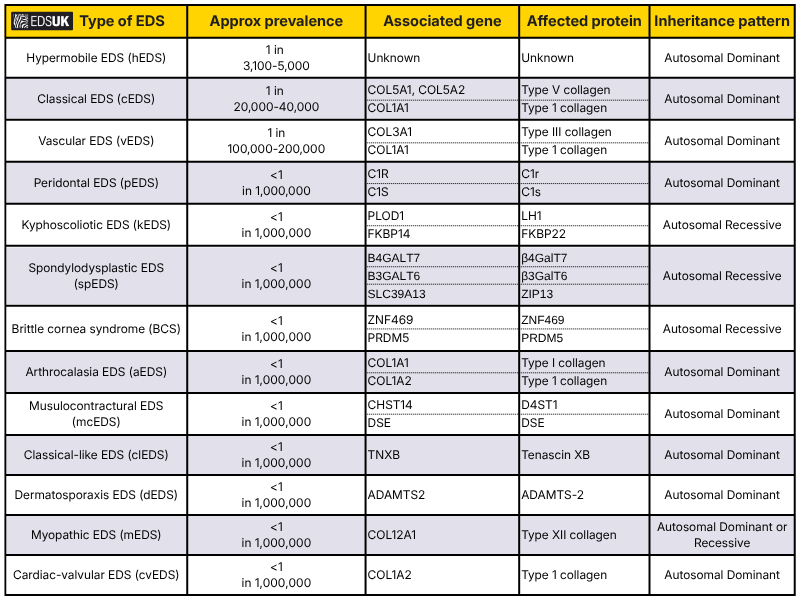
Table of EDS types and genetic featuresEstimated prevalence, associated genes and proteins, and inheritance patterns of 13 EDS types.

Who we are

Useful webinars for healthcare professionals

The Ehlers-Danlos syndromes (EDS) GP Toolkit References

Key Points

  1. Miklovic T, Sieg VC. Ehlers Danlos Syndrome. Treasure Island (FL): StatPearls Publishing; 2021.
  2. Malfait F, Francomano C, Byers P, et al. The 2017 international classification of the Ehlers–Danlos syndromes. American journal of medical geneticsPart C, Seminars in medical genetics. 2017; 175(1):8-26. Available here.
  3. Tinkle B, Castori M, Berglund B, et al. Hypermobile Ehlers–Danlos syndrome (a.k.a. Ehlers–Danlos syndrome Type III and Ehlers–Danlos syndrome hypermobility type): Clinical description and natural history. American journal of medical genetics. Part C, Seminars in medical genetics. 2017;175(1):48–69. Available here.
  4. Gazit Y, Jacob G, Grahame R. Ehlers-Danlos Syndrome-Hypermobility Type: A Much Neglected Multisystemic Disorder. Rambam Maimonides Medical Journal. 2016;7(4): e0034. Available here.
  5. Song B, Yeh P, Harrell J. Systemic manifestations of Ehlers-Danlos syndrome. Proceedings (Baylor University. Medical Centre). 2020;34(1):49-53. Available here.
  6. Tinkle B, Malfait F, Francomano C, Byers P, et al. The Ehlers-Danlos Syndromes: Reports from the International Consortium on the Ehlers-Danlos Syndromes. American journal of medical genetics. Part C, Seminars in medical genetics. 2017;175(1):1-245.
  7. Berengere AR, Schwitzguebel A, Valerio, F, et al. Are patients with hypermobile Ehlers–Danlos syndrome or hypermobility spectrum disorder so different? Rheumatology International.2021;1785–1794(41) Available here.
  8. Demmler J, Atkinson M, Reinhold E, et al. Diagnosed prevalence of Ehlers-Danlos syndrome and hypermobility spectrum disorder in Wales, UK: a national electronic cohort study and case–control comparison. BMJ Open. 2019;9(11): e031365. Available here.
  9. Castori M, Dordoni C, Valiante M, et al. Nosology and inheritance pattern(s) of joint hypermobility syndrome and Ehlers-Danlos syndrome, hypermobility type: A study of intrafamilial and interfamilial variability in 23 Italian pedigrees. American Journal of Medical Genetics Part A. 2014;164A(12):3010–3020.
  10. Collins H. If you can’t connect the issues, think connective tissues” Connecting the Dots Between Ehlers-Danlos Syndrome and Related Conditions. Annual Conference. 2014
  11. Castori M, Celletti C, Camerota F. Ehlers–Danlos syndrome hypermobility type: a possible unifying concept for various functional somatic syndromes. Rheumatology International. 2013; 33(3): 819-21. Available here.
  12. Reinhold E. MUS or DEN. 2017 Editor’s Choice Letter. British Journal of General Practice British Journal of General Practice 2017; 67(657): 156. Available here.
  13. Hakim J. Rheumatology. 2012; 51(3): iii2 (I11). Available here.
  14. Engelbert R, Jull-Kristensen B, Pacey V, et al. The Evidence-Based Rationale for Physical Therapy Treatment of Children, Adolescents, and Adults Diagnosed with Joint Hypermobility Syndrome/Hypermobile Ehlers Danlos Syndrome. American Journal of Medical Genetics Part C (Seminars in Medical Genetics) 2017;175(1):158–167.
  15. Bregant T, Spevak M. Ehlers–Danlos Syndrome: Not Just Joint Hypermobility. Case Reports in Medicine. 2018;5053825(2018): 3. Available here.
  16. Levy H, Adam M, Ardinger H, et al. Hypermobile Ehlers-Danlos Syndrome In: GeneReviews® [Internet]. Seattle (WA): University of Washington, Seattle; 1993-2021. Available here.
  17. Sutcliff J. Gastrointestinal problems in children with Ehlers-Danlos syndrome – The Ehlers-Danlos Support UK. [Internet]. EDS UK; [reviewed 2016 March 01]. Available here.
  18. de Kort LM, Verhulst J, Engelbert R, Uiterwaal C, et al. Lower urinary tract dysfunction in children with generalized hypermobility of joints. J Urol. 2003;170(5):1971–1974.
  19. Adib N, Davies K, Grahame R, et al. Joint hypermobility syndrome in childhood. A not so benign multisystem disorder? Rheumatology. 2005;44(6):744–750.
  20. Reilly D, Chase J, Hutson J, et al. Connective tissue disorder—A new subgroup of boys with slow transit constipation? J Pediatr Surg. 2008;43(6):1111–1114.
  21. Pacey V, Adams R, Tofts L, et al. Joint hypermobility syndrome subclassification in paediatrics: A factor analytic approach. Arch Dis Child.2015;100(1):8–13.
  22. Kovacic K, Chelimsky T, Sood M, et al. Joint hypermobility: A common association with complex functional gastrointestinal disorders. J Pediatr. 2014;165(5):973–978. Available here.
  23. Hasija R, Khubchandani R, Shenoi S. Joint hypermobility in Indian children. Clin Exp Rheumatol. 2008;26(1):146–150.
  24. Fikree A, Chelimsky G, Collins H, Kovacic K, et al. Gastrointestinal involvement in the Ehlers–Danlos syndromes. Am J Med Genet C Semin Med Genet. 2017;175(1):181–7.
  25. Alomari M, Hitawala A, Chadalavada P, et al. Prevalence and Predictors of Gastrointestinal Dysmotility in Patients with Hypermobile Ehlers-Danlos Syndrome: A Tertiary Care Center Experience. Cureus. 2020;12(4): e7881. Available here.
  26. Murray K, Woo P. Benign joint hypermobility in childhood. Rheumatology. 2001;40(5):489–491. Available here.
  27. Glans M, Thelin N, Humble M, Elwin M, et al. Association between adult attention-deficit hyperactivity disorder and generalised joint hypermobility: A cross-sectional case control comparison. Journal of Psychiatric Research. 2021;143:334-340. Available here.
  28. Ghibellini G, Brancati F, Castori M. Neurodevelopmental attributes of joint hypermobility syndrome/Ehlers-Danlos syndrome, hypermobility type: Update and perspectives. Am J Med Genet C Semin Med Genet. 2015;169C(1):107-16. Available here.
  29. Savage G, Csecs J, Davies G, et al. #3085 Relationship between variant connective tissue (hypermobility) and autism sensory processing: externally oriented thinking as a mediator. Journal of Neurology, Neurosurgery & Psychiatry. 2021;92:A7-A8.
  30. Casanova E, Baeza-Velasco C, Buchanan C, Casanova M. The Relationship between Autism and Ehlers-Danlos Syndromes/Hypermobility Spectrum Disorders. J Pers Med. 2020;10(4):260. Available here.
  31. Skalny A V, Skalny A A, Lobanova Y, et al. Serum amino acid spectrum in children with autism spectrum disorder (ASD). Research in Autism Spectrum Disorders. 2020;77:101605. Available here.
  32. Gaisi T, Giunta C, Bratton D, et al. Obstructive sleep apnoea and quality of life in Ehlers-Danlos syndrome: a parallel cohort study. 2017;72(8):729-735. Available here.
  33. Domany K, Hatragool S, Smith D, et al. Sleep Disorders and Their Management in Children With Ehlers-Danlos Syndrome Referred to Sleep Clinics. J Clin Sleep Med. 2018;14(4):623-629.
  34. Stöberl A, Gaisl T, Giunta C, et al. Obstructive Sleep Apnoea in Children and Adolescents with Ehlers-Danlos Syndrome. Respiration. 2019;97(4):284-291. Available here.
  35. Moss C, Fernandez-Mendoza J, Schubart J, et al. 0924 Nighttime Sleep and Daytime Functioning in Ehlers-Danlos Syndrome: A Cohort Study of Syndrome Subtypes. Sleep. 2018;41(1):A343-A343. Available here.
  36. Baeza-Velasco C, Bossche T, Grossin D, Hamonet C. Difficulty eating and significant weight loss in joint hypermobility syndrome/Ehlers-Danlos syndrome, hypermobility type.  Eat Weight Disord. 2016;21(2):175-83. Available here.
  37. Cutts R, Meyer R, Thapar N, et al. Gastrointestinal food allergies in children with Ehlers Danlos type 3 syndrome. The Journal of Allergy and Clinical Immunology. 2012;129(2):AB34. Available here.
  38. Baeza-Velasco C, Lorente S, Tasa-Vinyals E, et al. Gastrointestinal and eating problems in women with Ehlers–Danlos syndromes. Eat Weight Disord. 2021;26(8):2645-2656. Available here.
  39. Hunter A, Morgan A, Bird H. A survey of Ehlers-Danlos syndrome: Hearing, voice, speech and swallowing difficulties. Is there an underlying relationship? Br J Rheumatol1998;37(7):803–804. Available here.
  40. Hunter A. Speech, language, voice and swallowing in the Ehlers-Danlos syndromes – Chewing and swallowing section. 2017. Available here. (accessed 25/11/2021)
  41. Bulbena A, Baeza-Velasco C, Bulbena-Cabré, et al. Psychiatric and psychological aspects in the Ehlers–Danlos syndromes. Am J Med Genet C Semin Med Genet. 2017;175(1):237–245. Available here.
  42. Collins H. Ehlers-Danlos Syndrome’s Effect on Gastrointestinal Function. 2013. Available here.
  43. Collins H. Diet and Supplementation Guide for EDS. 2015. Available here.
  44. Csecs J, Dowell N, Savage G, et al. Variant connective tissue (joint hypermobility) and dysautonomia are associated with multimorbidity at the intersection between physical and psychological health. Am J Med Genet C Semin Med Genet.2021;187(4):500-509. Available here.
  45. Eccles J, Beacher F, Gray M, et al. Brain structure and joint hypermobility: relevance to the expression of psychiatric symptoms. Br J Psychiatry. 2012;200(6):508-509. Available here.
  46. Singh H, McKay M, Baldwin J, et al. Beighton scores and cut-offs across the lifespan: cross-sectional study of an Australian population. Rheumatology. 2017;56(11):1857–1864. Available here.
  47. Castori M, Sperduti I, Celletti C, et al. Symptom and joint mobility progression in the joint hypermobility syndrome (Ehlers–Danlos syndrome, hypermobility type). Clin Exp Rheumatol. 2011;29(6):998– 1005.
  48. Hakim A, O’Callaghan C, De Wandele I, et al. Cardiovascular autonomic dysfunction in Ehlers–Danlos syndrome—Hypermobile type. Am J Med Genet C Semin Med Genet. 2017;175(1):168–174. Available here.
  49. Mathias C, Owens A, Iodice V, et al. Dysautonomia in the Ehlers–Danlos syndromes and hypermobility spectrum disorders—With a focus on the postural tachycardia syndrome. Am J Med Genet C Semin Med Genet. 2021;187(4):510-519. Available here.
  50. Seneviratne S, Maitland A, Afrin L. Mast cell disorders in Ehlers–Danlos syndrome. Am J Med Genet C Semin Med Genet. 2017;175:226–36
  51. Afrin L. Some cases of hypermobile Ehlers–Danlos syndrome may be rooted in mast cell activation syndrome. American Journal of Medical Genetics Part C: Seminars in Medical Genetics. 2021;187(4):466-472. Available here.
  52. Brock I, Prendergast W, Maitland A. Mast cell activation disease and immunoglobulin deficiency in patients with hypermobile Ehlers-Danlos syndrome/hypermobility spectrum disorder. Am J Genet C Semin Med Genet. 2021;187(4):473-481. Available here.
  53. Fikree A, Aktar R, Grahame R, et al. Functional gastrointestinal disorders are associated with the joint hypermobility syndrome in secondary care: A case-control study. Neurogastroenterol Moti. 2015;27(4):569–579. Available here.
  54. Castori M. Tinkle B, Levy H, et al. A Framework for the Classification of Joint Hypermobility and Related Conditions. Am J Med Genet Part C Semin Med Genet. 2017;175(1):148–157. Available here.
  55. Beckers A, Keszthelyi D, Fikree A, et al. Gastrointestinal disorders in joint hypermobility syndrome/Ehlers-Danlos syndrome hypermobility type: A review for the gastroenterologist. Neurogastroenterol Motil. 2017;29(8):e13013. Available here.

When to suspect EDS

  1. Rombaut L, Malfait F, Cools A, et al. Musculoskeletal complaints, physical activity and health-related quality of life among patients with the Ehlers–Danlos syndrome hypermobility type. Disabil Rehabil.2010;32(16):1339–1345. Available here.
  2. Castori M, Dordoni C, Valiante M, et al. Nosology and inheritance pattern(s) of joint hypermobility syndrome and Ehlers–Danlos syndrome, hypermobility type: A study of intrafamilial and interfamilial variability in 23 Italian pedigrees. Am J Med Genet A. 2014;164A(12):3010–3020. Available here.
  3. Scheper M, Juul-Kristensen B, Rombaut L, et al. Disability in adolescents and adults diagnosed with hypermobility related disorders: A meta-analysis. Arch Phys Med Rehabil. 2016;97(12):2174–2187. Available here.
  4. Juul-Kristensen B, Schmedling K, Rombaut L, et al. Measurement properties of clinical assessment methods for classifying generalized joint hypermobility—A systematic review. Am J Med Genet C Semin Med Genet. 2017;175(1):116-147. Available here.
  5. Tinkle B, Castori M, Berglund B, et al. Hypermobile Ehlers–Danlos syndrome (a.k.a. Ehlers–Danlos syndrome Type III and Ehlers–Danlos syndrome hypermobility type): Clinical description and natural history. Am J Med Genet C Semin Med Genet. 2017;175(1):48–69. Available here.
  6. Alomari M, Hitawala A, Chadalavada P et al. Prevalence and Predictors of Gastrointestinal Dysmotility in Patients with Hypermobile Ehlers-Danlos Syndrome: A Tertiary Care Center Experience. 2020;12(4):e7881. Available here.
  7. Fikree A, Aktar A, Grahame R, et al. Functional gastrointestinal disorders are associated with the joint hypermobility syndrome in secondary care: A case-control study. Neurogastroenterol Motil2015;27(4):569–579.
  8. Cheung I, & Vedas P. A New Disease Cluster: Mast Cell Activation Syndrome, Postural Orthostatic Tachycardia Syndrome, and Ehlers-Danlos Syndrome. Journal of Allergy and Clinical Immunology. 2015;135(2):AB65. Available here.
  9. Seneviratne S L, Maitland A, Afrin L. Mast cell disorders in Ehlers–Danlos syndrome. Am J Med Genet C Semin Med Genet. 2017;175:226–36. Available here.
  10. Afrin L B. Some cases of hypermobile Ehlers–Danlos syndrome may be rooted in mast cell activation syndrome. Am J Med Genet C Semin Med Genet. 2021;187(4):466-472. Available here.
  11. Brock I, Prendergast W, Maitland A. Mast cell activation disease and immunoglobulin deficiency in patients with hypermobile Ehlers-Danlos syndrome/hypermobility spectrum disorder. Am J Med Genet C Semin Med Genet. 2021;187(4):473-481. Available here.
  12. Hakim A, O’Callaghan C, De Wandele I, et al. Cardiovascular autonomic dysfunction in Ehlers–Danlos syndrome—Hypermobile type. Am J Med Genet C Semin Med Genet. 2017;175(1):168–74. Available here.
  13. De Wandele I, Rombaut L, Backer T, et al. Orthostatic intolerance and fatigue in the hypermobility type of 14 Ehlers-Danlos Syndrome. 2016;55(8)8:1412-1420. Available here.
  14. Hakim A, Wandele I, O’Callaghan C, et al. Chronic fatigue in Ehlers–Danlos syndrome—Hypermobile type. Am J Med Genet Part C Semin Med Genet. 2017;175(1):175–80. Available here.
  15. Malfait F, Francomano C, Byers P, et al. The 2017 international classification of the Ehlers–Danlos syndromes. Am J Med Genet C Semin Med Genet.2017;175(1):8-26. Available here.
  16. Levy H. Hypermobile Ehlers-Danlos Syndrome. Seattle (WA): University of Washington; 2004.
  17. Donohue P, Chavirmootoo S, Ramakrishnan S. AB1411-HPR Hypermobility and fibromyalgia: coexistence or mistaken identity? Annals of the Rheumatic Diseases.2018;77:1840-1841.
  18. Lam C Y, Palsson O S, Whitehead W E, et al. Rome IV Functional Gastrointestinal Disorders and Health Impairment in Subjects With Hypermobility Spectrum Disorders or Hypermobile Ehlers-Danlos Syndrome. Clin Gastroenterol Hepatol. 2021 Feb;19(2):277-287.e3. Available here.
  19. Sulli A, Talarico R, Sciré C, et al. Ehlers-Danlos syndromes: state of the art on clinical practice guidelines. RMD Open.2018;4(1):e000790. Available here.
  20. Beckers A B, Keszthelyi D, Fikree A, et al. Gastrointestinal disorders in joint hypermobility syndrome/Ehlers-Danlos syndrome hypermobility type: a review for the gastroenterologist. Neurogastroenterol Motil. 2017;29(8):e13013.

Diagnosing hEDS in primary care

  1. Malfait F, Francomano C, Byers P, et al. The 2017 international classification of the Ehlers–Danlos syndromes. Am J Med Genet C Semin Med Genet2017;175(1):8-26. Available here.
  2. Castori M, Tinkle B, Levy H, et al. A Framework for the Classification of Joint Hypermobility and Related Conditions. Am J Med Genet Part C Semin Med Genet. 2017;175(1):148–157. Available here.
  3. Atwell K, Michael W, Dubey J, et al. Diagnosis and Management of Hypermobility Spectrum Disorders in Primary Care. The Journal of the American Board of Family Medicine Jul 2021;34(4);838-848. Available here.
  4. Demmler JC, Atkinson MD, Reinhold EJ, et al. Diagnosed prevalence of Ehlers-Danlos syndrome and hypermobility spectrum disorder in Wales, UK: a national electronic cohort study and case–control comparison. BMJ Journals 2019;9:e031365. Available here.
  5. Grahame R, Hakim A, Tofts L et al. Treatment and prognosis of hypermobile Ehlers-Danlos syndrome and hypermobility spectrum disorder [internet] com [14/12/2021). Available here.
  6. ICD- 10 Coded. ICD Code for Hypermobile Ehlers-Danlos Syndrome [14/12/21].

Emerging major associations

  1. Hakim A, O’Callaghan C, De Wandele I, et al. Cardiovascular autonomic dysfunction in Ehlers–Danlos syndrome—Hypermobile type. Am J Med Genet C Semin Med Genet. 2017;175(1):168–74. Available here.
  2. Celletti C, Camerota F, Castori M, et al. Orthostatic intolerance and postural orthostatic tachycardia syndrome in joint hypermobility syndrome/Ehlers-Danlos syndrome, hypermobility type: Neurovegetative dysregulation or autonomic failure? BioMed Res Int. 2017;2017:9161865. Available here.
  3. Tinkle B, Castori M, Berglund B, et al. Hypermobile Ehlers–Danlos syndrome (a.k.a. Ehlers–Danlos syndrome Type III and Ehlers–Danlos syndrome hypermobility type): Clinical description and natural history. Am J Med Genet C Semin Med Genet. 2017;175(1):48–69. Available here.
  4. Mathias C, Owens A, Iodice V, et al. Dysautonomia in the Ehlers–Danlos syndromes and hypermobility spectrum disorders—With a focus on the postural tachycardia syndrome. Am J Med Genet C Semin Med Genet. 2021;187(4):510-519. Available here.
  5. De Wandele I, Rombaut L, Backer T, et al. Orthostatic intolerance and fatigue in the hypermobility type of Ehlers-Danlos Syndrome. Rheumatology. 2016;55(8):1412–1420. Available here.
  6. Kanjwal K, Saeed B, Karabin B, et al. Comparative clinical profile of postural orthostatic tachycardia patients with and without joint hypermobility syndrome. Indian Pacing Electrophysiol J. 2010;10(4):173-178.
  7. Zaldumbide-Alcocer L, Jiménez-Ruiz, & Estaňol-Vidal B. BS05. Orthostatic hypotension and syncope in patients with ehlers-danlos syndrome. Clinical Neurophysiology. 2018;129(1):e214-e215. Available here.
  8. Rowe P, Barron D, Calkins H, et al. Orthostatic intolerance and chronic fatigue syndrome associated with Ehlers Danlos syndrome. J Pediatr. 1999:135(4):494–499. Available here.
  9. Hakim AJ & Grahame R. Non-musculoskeletal symptoms in Joint Hypermobility syndrome: Indirect evidence for autonomic dysfunction. 2004;43(9):1194–1195. Available here.
  10. Mathias C, Low D, Iodice V, et al. Postural tachycardia syndrome—Current experience and concepts. Nat Rev Neurol. 2011;8(1):22–34. Available here.
  11. De Wandele I, Calders P, Peersman W, et al. Autonomic symptom burden in the hypermobility type of Ehlers–Danlos syndrome: A comparative study with two other EDS types, fibromyalgia, and healthy controls. Seminars in Arthritis and Rheumatism. 2014;44(3):353-361. Available here.
  12. Freeman R, Wieling W, Axelrod F, et al. Consensus statement on the definition of orthostatic hypotension, neurally mediated syncope and the postural tachycardia syndrome. Clin Auton Res. 2011;21(2):69-72. Available here.
  13. Afrin LB. Some cases of hypermobile Ehlers–Danlos syndrome may be rooted in mast cell activation syndrome. American Journal of Medical Genetics Part C: Seminars in Medical Genetics. 2021:187(4):466 – 472. Available here.

Indication for referral in EDS

  1. Malfait F, Francomano C, Byers P, et al. The 2017 international classification of the Ehlers-Danlos syndromes. Am J Med Genet C Semin Med Genet. 2017;175(1):8-26. Available here. PMID: 28306229.
  2. Byers P, Belmont J, Black J, et al. Diagnosis, natural history, and management in vascular Ehlers–Danlos syndrome. American Journal of Medical Genetics Part C: Seminars in Medical Genetics. 2017;175(1):40-47.
  3. Ehlers-Danlos syndrome. Section: Getting medical advice (Accessed 22/12/2021) Available here.