So you have either been diagnosed with (or think you might have) or heard of Ehlers-Danlos Syndrome (aka EDS) or Hypermobility spectrum disorder (aka HSD)?
But what actually are Ehlers-Danlos Syndrome and Hypermobility spectrum disorder?
Mia explains.
Hypermobility spectrum disorder (HSD) and Ehlers Danlos syndrome (EDS) is a group of connective tissue disorders caused by a fault in the collagen genes. Collagen is a protein that makes up connective tissue, collagen is everywhere in your body from your eyes, blood vessels and even teeth. A good way to remember what collagen does in the body is to think of it like the body’s glue that holds everything together.
Collagen is a protein within the body that are major building blocks in making the muscles, connective tissue, blood vessels, bones, skin.(Cleveland Clinic 2022) When the genes have the wrong code the collagen is not made correctly. You can think of this like a computer that has been made incorrectly so it doesn’t open up your favourite game.
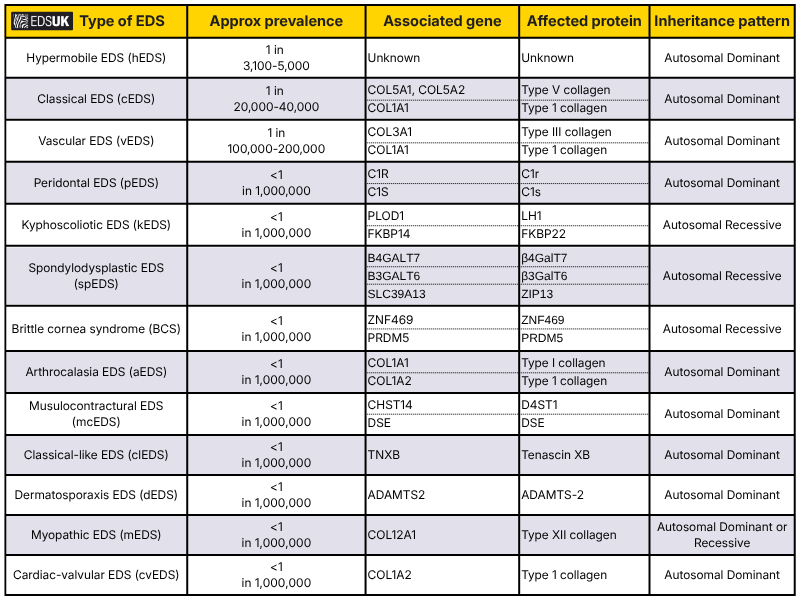
There are 13 different types of EDS and you can find a list of them here.
Key facts:
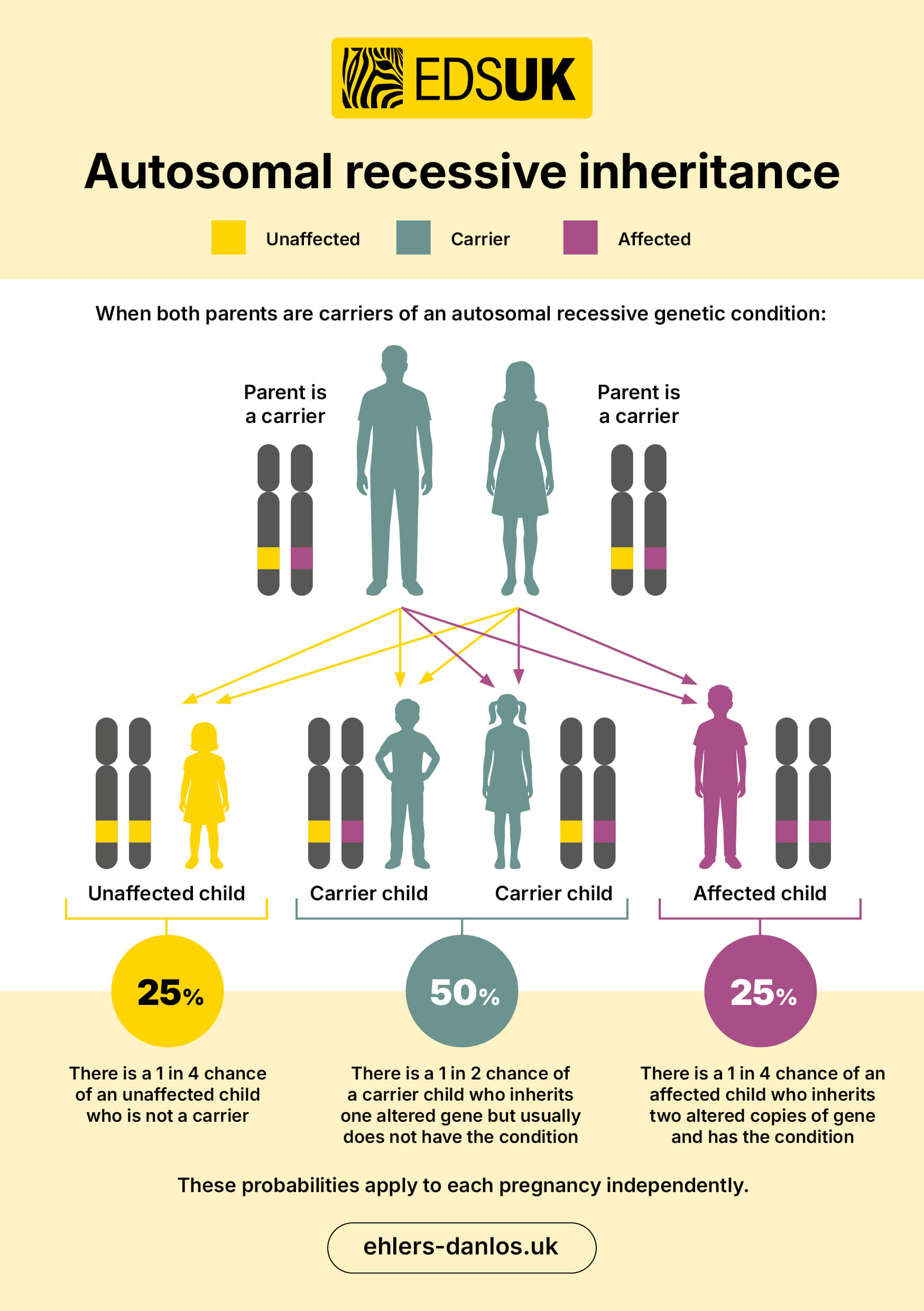
Ehlers-Danlos syndrome can be passed down through families, this is known as inheritance. Some types of EDS can be autosomal dominant and some are autosomal recessive. Apart from myopathic which can be inherited by either autosomal dominant or autosomal recessive.
It is also important to note that you can only pass on the type of EDS that you have. E.g. a individual with vascular EDS can’t pass on classical EDS.
All types of EDS, apart from Hypermobile EDS (hEDS can only be diagnosed clinically), can be genetically tested for in addition to clinical observation. Clinical observation includes taking a history of personal medical history, family history, Beighton score.
The general symptoms of eds are (but not limited to) joint pain, dislocations and subluxations, fatigue, gastrointestinal issues, dental issues, dysautonomia
Heidi goes on to say…
Approximately 50% of individuals diagnosed with cEDS have an affected parent.
Our bodies are made up of roughly 30 trillion cells and every cell has a nucleus, the nucleus controls what happens in the cell and inside of every nucleus are chromosomes. Normally each cell in the human body has 23 pairs of chromosomes and all chromosomes are made of DNA: molecules that contain genetic information, these are called genes. The main function of genes is to instruct your cells to make proteins which are needed for the body to function, this can be anything from muscle, to bones, to cartilage, connective tissue, and any other of our internal structures.
Since EDS is a connective tissue disorder, it most likely is formed from an alteration gene, or several genes that contain the instructions for making up connective tissue. In hypermobile, classical and vascular EDS it is found that the faulty gene in which causes EDS is passed on by one of the parents and there is a 1 in 2 chance of their child/ each of their children developing the condition, in a small minority of causes the genetic factors involved have been identified though in the vast majority of cases the leading cause of EDS is not yet to be identified.