My story – Jessica
‘You’re like an onion’ is a sentence that I was not particularly prepared to hear from my doctor during a recent appointment. ‘With each layer that you peel back, something else appears in its place’. Despite the atypical nature of this statement, it is one that I, and I’m sure many patients with Ehlers-Danlos syndrome, hear regularly from healthcare professionals; really, the underlying message is that ‘Your condition is very complex’.
Wide-spread joint pain, unexplained bruising and recurrent muscle sprains were only several of the many symptoms that marked the beginning of my journey with Ehlers-Danlos syndrome as a child. This, however, did not stop me from exploring the world around me as though it were my own personal playground (though rests were much needed afterwards)! Despite unknowingly living with the condition at such a young age, it became much more apparent to me that something wasn’t quite right after I encountered an unexpected health decline as a teenager.
After starting my first year at sixth form, I began to experience strange episodes of low blood sugar, which gradually progressed in frequency from once a week to twice, possibly even three times, a day. Paired with my steadily worsening weight loss, muscle weakness and debilitating fatigue, studying for my A-Level’s, and maintaining a social life became near impossible tasks.
The upcoming appointment-filled months culminated in my eventual diagnosis of Adrenal Insufficiency, a condition that occurs when the body doesn’t make enough of the steroid hormone cortisol. I was subsequently started on treatment, and have been on treatment ever since, however it quickly became apparent that Adrenal Insufficiency was not my only cause for concern. At this stage, I began to feel slightly hopeless – what could possibly be causing so many separate, unrelenting issues?
The journey that led to a diagnosis of Hypermobile Ehlers-Danlos Syndrome in 2024 was both difficult and undeniably eye-opening. It all clicked together, explaining the physical differences that I had grappled with throughout my entire childhood, and still do to this day. From unrecognised ADHD to, almost comical, clumsiness, it was a tremendous relief to finally be able to put a name to the underlying reason! Diagnosis was a critical moment for me and having the crucial ability to simply understand my own body felt like half of the battle.
A further diagnosis of AVP Deficiency later, it occasionally still does feel as though the doctors’ appointments, hospital tests and medication prescriptions may never come to an end! With time it has become much easier to manage and I am continuing to learn how to best balance my illnesses alongside my life, and the things that matter to me the most. One reminder that I, personally, have found very helpful is that, even though my illnesses do significantly impact me, they don’t define me as an individual.
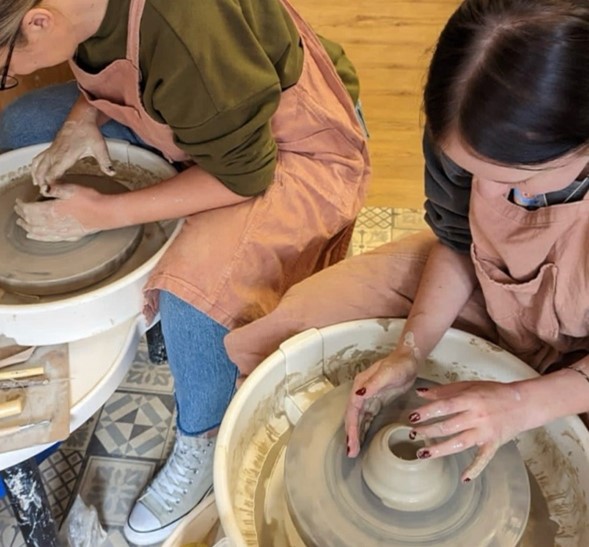
Regardless of the obstacles that I was presented with during my time at sixth form, I still managed to achieve my A-level’s and I am now studying for two further A-Level’s online in biology and chemistry – my experiences have given me the courage to go after my true motivations, and hopefully pursue a career in the healthcare field! For many people with EDS, it is inevitable that your healthcare needs might start to creep their way up your list of priorities. But it’s important to try to equally prioritise your happiness – for me, this means making time, when I can, for the things that bring me joy (e.g. pottery).
We may be ‘onions’ (complex, and somewhat difficult for other people to understand) but I have come to understand that I would not be who I am today without having lived through what I have. I look forward to, someday, being able to utilise the things I have learned along the way in order to help other people who are living through similar experiences!
Top tips
The symptoms that can affect people with EDS or HSD are very different between individuals and can even differ for you from one week to the next. This, paired with the wide range of possible symptoms and conditions associated with EDS and HSD can make it tricky to cope with your symptoms.
My first tip is to determine which of your symptoms you struggle with the most. This will make it easier to tailor your treatment and management plan to you as an individual, because what works for one person might not work for others. You could do this by keeping a diary of your symptoms, either using a notebook and pen or an app on your phone, to see how they change over time.
My second tip is to always pace yourself! Separate tasks and activities into three categories depending on how much energy they take up using a red, amber, and green system (with red tasks taking up the most energy, and green tasks taking up the least). Every day, you should try to do only one red task. This can help you to better manage your pain and energy levels throughout the day!
My final tip is to use trial and error! It is important that, where you can, you try out different ways to manage your symptoms. Heat, ice, hand-held massagers and even distraction techniques are a few of the methods that you could benefit from. Through trial and error, you will be able to build up your tool kit over time, so that when you do experience symptoms, they will be much easier for you manage. Learn what works best for you!